

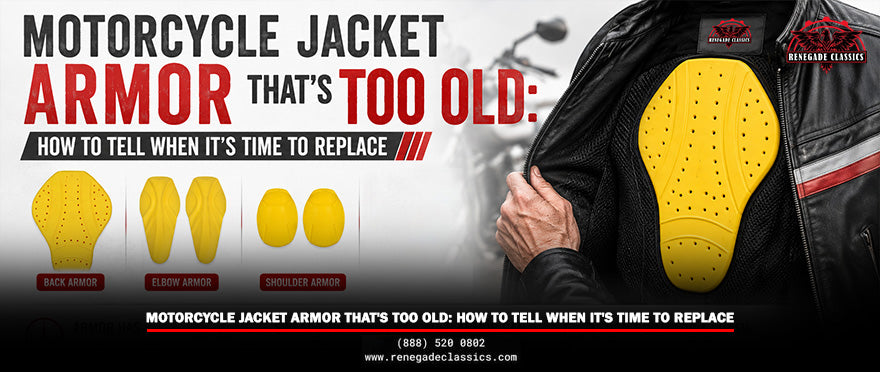
Riders track their tire tread and change their oil on a schedule. Most never check the foam sitting against their spine.
That foam does the real work when a jacket ends up sliding across asphalt. It has to absorb impact energy before it reaches your shoulder, elbow, or back. Left in a jacket for years, that same foam hardens, cracks, or flattens out until it's providing decoration instead of protection.
Motorcycle jacket armor has a service life. It's shorter than most riders think, and it runs out quietly. No sensor tells you the foam has failed. The only way to know is to check it yourself, understand what breaks it down, and replace it before you find out the hard way.
Yes, Motorcycle Armor Expires. Here's Why
Motorcycle armor is a foam or hard-shell insert, not a permanent shield. Foam breaks down chemically over time, the same way a couch cushion loses its bounce after a decade of sitting. Riding gear just asks more of that foam: heat, sweat, sunlight, and the occasional hard hit.
Armor doesn't need a crash to start failing. A jacket that's spent five summers in a closet or strapped to a bike seat in direct sun has already lost some of its impact absorption, even if it's never touched the road.
How Foam Armor Breaks Down
Three things wear armor out before a crash ever happens. Each one works differently, and most riders deal with all three at once without realizing it.
Compression
Foam holds its shape through thousands of tiny air pockets. Every time you sit, lean, or shift in the saddle, those pockets compress. Over years of regular riding, the foam stops springing back fully. It settles into a flatter, denser version of itself, and flatter foam has less room to absorb an impact.
UV Damage
Sunlight breaks down the polymer chains in foam even through fabric. A jacket hung near a window, or a bike parked outside all summer, exposes the armor to slow, steady UV damage. The foam turns brittle from the inside before any change shows on the surface.
Sweat Absorption
Sweat carries salt and body oil into the fabric and straight into the foam. That buildup breaks down the foam's cell structure from the inside, the same way it damages a helmet liner. Riders who never remove the armor before washing a jacket speed up the process without realizing it.
The Visual and Physical Signs Your Armor Needs Replacing

-
Permanent dents: Check whether the armor has dents that do not return to their original shape.
-
Color changes: Look for foam that appears lighter, duller, or different in color from the rest of the pad.
-
Cracking or flaking: Flex the armor and check for visible cracks, flakes, or surface damage.
-
Thinner padding: Compare the pad with its original condition. Noticeably compressed or thinner armor may no longer offer the same protection.
-
Poor positioning: Is your motorcycle jacket armor sitting over your joints the way it did when the jacket was new? Armor should stay aligned with your shoulders, elbows, and other impact areas while you are in your riding position.
-
Shifted armor: Compressed or hardened foam can move out of place over time. Even a one-inch shift can leave the intended impact area exposed.
The Squeeze Test: Check Your Armor at Home
You don't need a lab to check your armor. A five-minute test at your kitchen table tells you most of what you need to know.
-
Pull each insert out of its pocket. Don't test it through the fabric, since the outer shell can hide a lot of foam damage.
-
Squeeze the pad firmly between your thumb and fingers.
-
Bend it in half and watch how it responds.
-
Check for consistent color and texture across the whole pad.
Good foam feels firm but flexible, and it returns to its original shape within a second or two of release. Bad foam feels rock hard, cracks or flakes under pressure, or turns visibly lighter where you bent it. If your armor fails any part of this test, it's done.
Hard Armor vs. Soft Armor: Which Degrades Faster

Soft foam and hard-shell armor fail differently, and knowing which one is in your jacket changes what to watch for.
Soft viscoelastic foam, the kind found in most modern CE Level 1 and Level 2 inserts, degrades gradually. It gets denser and less responsive over years of exposure to heat and sweat, which is why the squeeze test works so well on it.
Hard-shell armor fails less predictably. The plastic can look completely intact while going brittle underneath from age and UV exposure. A shell that's lost its flexibility can crack or shatter on the first real hit instead of absorbing it, and there's often no visible warning before that happens.
A back protector in a motorcycle jacket is usually the largest single piece of armor a rider owns, and it's also the piece most riders never check. Because it covers the spine, a compressed or brittle back protector is one of the more serious gaps in a rider's setup. If you can only test one piece of armor today, make it that one.
After a Crash, Replace It. Even If It Looks Fine
Impact can crush the foam's internal cell structure without leaving a mark on the outside. A pad that took a hit in a low-speed drop might look untouched while its ability to absorb a second impact is already gone.
This applies to hard shells too. A crack can form beneath the surface, remaining invisible until the shell fails on the next impact. There's no way to inspect your way around this one. Any armor involved in a crash, drop, or hard hit gets replaced, regardless of how it looks afterward. No exceptions.
How Long Should Motorcycle Armor Actually Last
There's no universal expiration date stamped on a piece of armor, but the ranges are consistent across the industry.
Budget polyurethane foam, the kind found in lower-cost gear, starts breaking down in as little as two to three years. Certified viscoelastic foam, like the SAS-TEC and D3O-style inserts used in higher-end jackets, typically holds up for five to seven years under regular use. Riders in hot, humid climates or those putting on serious daily mileage should check theirs closer to the front of that range.
Storage and care push those numbers in either direction. A jacket kept out of direct sun, with the armor removed before washing, holds its protection longer than one left baking in a hot garage. The same care principle applies to the leather itself. If you're already maintaining the outer shell with the leather conditioners for your motorcycle jacket, add a quick armor check to that same routine. For a broader rundown of what else deserves regular attention, these things to know about motorcycle gear cover the basics worth revisiting each season.
Replacing Armor Inserts: What to Buy and How to Fit Them
Replacing armor is one of the simpler upgrades available for existing gear, and it doesn't require a new jacket.
Start by pulling the old insert and checking its label for a CE rating and an EN standard. Limb armor is tested under EN 1621-1, and back protectors under EN 1621-2. No label means the pad was never certified in the first place, which is worth knowing before you decide whether to replace it or upgrade it.
Measure the old insert's dimensions before ordering a replacement. Most manufacturers have converged on similar pocket sizes over the past decade, so a new CE Level 2 insert usually fits within 5 to 10 percent of the original, even across different brands. Slight differences in width or height are normal since foam contours once it's back in the pocket.
Renegade Classics has outfitted riders since 1991, and that history comes with a plain understanding: armor only works when it's sized right and sitting where it belongs. Riders shopping for a full upgrade rather than a swap can start with the armored motorcycle jackets collection, built around CE-rated inserts from the start. Riders who just need replacement pads or a standalone protector can go straight to the body armor collection.
Cover the Rest of Your Gear While You're At It
Armor doesn't work in isolation. It's one piece of a full setup that includes the jacket shell, gloves, boots, and helmet, and most of that gear ages on a similar timeline.
If the armor check turned up a jacket that's otherwise worn through at the seams or cracked at the shoulders, it might be time to look at the motorcycle jackets instead of just the inserts. While you're at it, give your gloves, boots, vests, and helmet the same once-over. Foam liners in helmets degrade the same way jacket armor does, and worn gloves or boots lose grip and protection long before they look obviously damaged. Riders restocking accessories at the same time might round out the bike with a set of bells, but the armor and abrasion gear come first.
Frequently Asked Questions
Does motorcycle jacket armor really expire?
Yes. Foam and hard-shell armor both degrade with age, heat, UV exposure, and sweat, even without a crash. Certified foam typically holds up for 5 to 7 years, while budget foam can start failing in 2 to 3.
How often should I replace CE armor?
Check it annually using the squeeze test. Replace certified viscoelastic foam every 5 to 7 years under normal use, sooner in hot or humid climates, and replace any armor involved in a crash immediately, regardless of visible damage.
Can I upgrade the armor in my current jacket?
In most jackets, yes. If the armor sits in a removable pocket rather than being sewn in, a CE Level 2 insert can usually replace the original pad. Measure the old insert first and check that the new one matches within about 5 to 10 percent.
Do I need to replace armor after a low-speed drop?
Yes. Impact can crush the internal structure of foam or crack a hard shell without leaving visible damage. A pad that absorbed one hit may not protect against a second, so any armor involved in a fall gets replaced.
What's the difference in lifespan between CE Level 1 and Level 2 armor?
Both degrade on a similar timeline, since the same environmental factors (heat, sweat, and UV) affect them. The difference is in impact capacity rather than lifespan: Level 1 is tested for impacts up to about 12 mph, while Level 2 handles higher-speed hits and transmits roughly half the force to the rider.
How do I know if my back protector is CE certified?
Check the label sewn into the insert itself, not the jacket. It should list the EN 1621-2 standard along with a CE Level 1 or Level 2 rating. If there's no label, the protector was never independently tested.
Can old armor be repaired instead of replaced?
No. Foam and hard-shell armor aren't designed to be repaired. Once foam has compressed, cracked, or lost its rebound, or a hard shell has gone brittle, replacement is the only option that restores real protection.


