

Key Takeaways
- A properly constructed riding flannel with aramid lining and CE-certified armor is genuine protective gear. The fact that it looks like casual clothing does not reduce its protective function.
- Two flannels can be visually identical and offer completely different levels of protection. The difference is in the construction, not the appearance. Knowing what to look for is the only way to tell them apart.
- The plain clothes approach has a practical advantage for the Harley and cruiser rider: protective gear that is comfortable enough to wear in every context, on the bike and off, gets worn more consistently than gear that is clearly riding-specific.
- The features that make a flannel protective gear are: aramid fiber lining at the key abrasion zones, CE-certified armor inserts at the shoulders and elbows, reinforced seam construction, and a riding-specific cut with extended back hem.
- A riding flannel is not a full motorcycle jacket. It provides meaningful protection at the zones it covers and should be understood within its actual protection profile, not compared to maximum gear.
- Verifying that your flannel is a genuine riding flannel requires checking the product description for specific construction features and confirming CE certification on the armor insert labels.
Biker flannel as protective motorcycle gear is a concept that confuses riders who associate safety equipment with high-visibility vests and full-coverage riding suits. A riding flannel looks like a shirt. It wears like a shirt. But a properly constructed riding flannel is doing something a regular shirt cannot do.
This article makes the case for the plain clothes riding approach and explains exactly what construction features turn a flannel into protective gear. It also covers how to verify that the flannel you are wearing or considering actually delivers what a riding flannel should.
For the full guide to what a motorcycle shirt can and cannot do in a crash, see the motorcycle shirt crash safety guide.
What 'Plain Clothes' Protection Actually Means
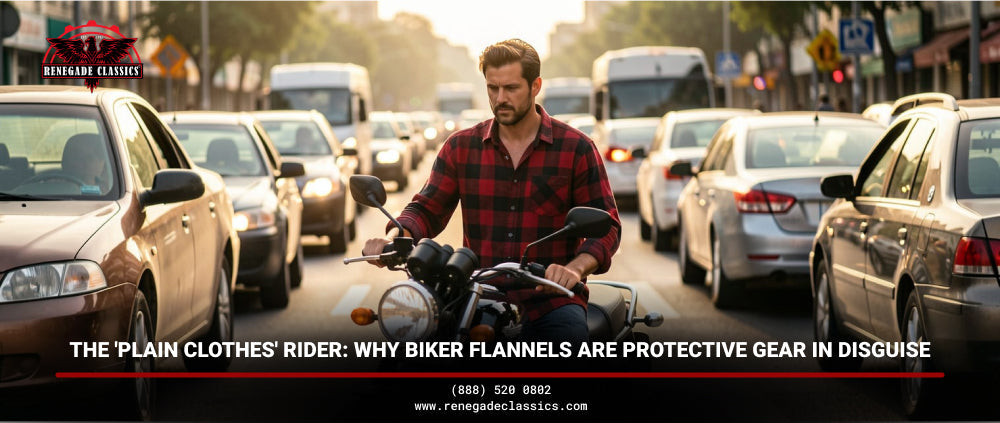
Plain clothes protection in the motorcycle context means wearing gear that provides genuine riding protection while looking like everyday clothing. The gear does not announce itself as safety equipment. It reads as a flannel shirt to everyone who sees it, including the rider in a mirror before they leave.
This is not a compromise on protection. It is a design approach. The protection comes from what is inside the garment: the aramid fiber woven into the lining at the key abrasion zones, the CE-certified armor inserts at the shoulders and elbows, and the reinforced seam construction that holds the garment together in a slide.
The outer appearance is flannel. The inner construction is riding protection. Both things are true at the same time.
The Two Types of Flannel That Look Identical
This is the central problem with evaluating riding flannels: a fashion flannel and a riding flannel can be photographed side by side and look the same. Same plaid pattern. Same snap closures. Same collar. Different everything underneath.
The fashion flannel is built to look and feel like a quality flannel shirt. It uses flannel-weight cotton, has snap closures, and is cut to a flattering fit. In a slide on pavement, it provides whatever protection the cotton fabric construction offers before it wears through. That protection is limited.
The riding flannel is built to function as riding protection that happens to look like a flannel shirt. It uses the same outer appearance but adds aramid lining at the critical abrasion zones, CE-certified armor at the shoulder and elbow joints, reinforced seam construction at the stress points, and a cut designed for a riding position.
The visual similarity is by design. The riding flannel is built this way because a garment that looks like casual clothing gets worn in more contexts, more consistently, and with less friction than a garment that looks like safety equipment.
What Separates a Protective Flannel from a Fashion One
Aramid Fiber Lining
Aramid fiber, including Kevlar and similar materials, is substantially stronger than cotton per unit weight and provides significantly more resistance to road abrasion than standard fabric. In a riding flannel, aramid lining is placed at the shoulder and elbow zones, which are the highest-priority abrasion contact zones in many common fall scenarios.
When the outer flannel fabric wears through in a slide, the aramid lining underneath continues to resist road contact. This is the primary protective function that separates a riding flannel from a fashion one. Without aramid lining, the protection depends entirely on how quickly the outer cotton flannel wears through.
The aramid lining is not visible from outside the shirt. It is sewn into the interior at the lined zones. Verify its presence in the product description. Terms like "Kevlar lining," "aramid lining," or "protective lining at key zones" indicate a riding-grade construction.
CE-Certified Armor Inserts
CE-certified armor at the shoulders and elbows addresses a different injury type from abrasion. Where aramid lining reduces skin contact with the road surface, CE armor absorbs and distributes impact force at the joints when the body strikes the ground.
A riding flannel includes dedicated armor pockets at the shoulders and elbows sized to hold CE-certified inserts. A fashion flannel has no such pockets. Some riding flannels also include a back pocket for an optional back protector insert.
Verify CE armor by checking the armor insert label for a CE Level 1 or CE Level 2 designation. The product description listing CE certification is not the same as verifying it on the insert. Remove the inserts and check the labels before riding.
Seam Construction
A riding flannel uses reinforced seam construction at the shoulder and underarm stress points. These seams take significant mechanical force in a fall and in the repeated stress of a riding position. Double-stitched seams or bar-tacked stress points keep the garment intact through the forces of a slide.
A fashion flannel uses standard garment seam construction optimized for appearance and daily wear comfort. These seams are adequate for their purpose but are not built to withstand the mechanical forces of road contact in a crash.
Extended Back Hem and Riding Cut
A riding flannel is cut for a riding position. The back hem is extended to remain at the waistband when the rider leans forward on the bike. Armor pockets are positioned to sit over the correct joint zones in a riding posture, not a standing posture.
A fashion flannel is cut for standing wear. In a riding position, the back hem typically rides up, the shoulder seam pulls forward, and any internal features shift away from their correct positions. These fit differences matter for both comfort and the effectiveness of any protective features present.
Why the Plain Clothes Approach Makes Sense for Harley Riders
The Harley and cruiser rider occupies a specific cultural position. The riding identity is expressed through the clothing: the flannel, the vest, the jeans, the boots. Gear that is visually consistent with this identity gets worn. Gear that disrupts it often does not.
A full motorcycle jacket provides more comprehensive protection than a riding flannel. It is also clearly a piece of safety equipment. At a summer rally, at a bar, at a casual social gathering on or after the ride, a full jacket signals that the wearer just got off a bike. A riding flannel signals that the wearer is a rider whose everyday clothing happens to include protective features.
This distinction matters practically. Riders who feel comfortable in their gear in every context from the saddle to a bar stool wear it more consistently. Riders who feel conspicuous in safety equipment change out of it more often. For riders who find a full jacket too uncomfortable or conspicuous to wear consistently, consistent wear of a riding flannel may provide more real-world protection than a jacket worn only occasionally.
The Protection Profile of a Riding Flannel
What It Protects Against
A properly constructed riding flannel with aramid lining and CE armor provides:
- Meaningful abrasion resistance at the aramid-lined zones in a slide. The aramid fiber resists road contact significantly better than cotton fabric.
- CE-certified impact protection at the shoulder and elbow joints. The armor absorbs and distributes impact force at the joint zones when the body strikes the road surface.
- Structural integrity through a crash if seam construction is adequate. A garment that holds together keeps its protective materials in position.
What It Does Not Protect Against
Honesty about limits is part of what makes the plain clothes approach credible:
- Zones not covered. Unlined torso areas, the forearms and wrists below the lining zones, all areas below the shirt hem, the hands, the legs, and the head are outside the shirt's protection.
- Very high-speed crashes. Purpose-built riding fabrics provide meaningful resistance. They are not unlimited in what they can absorb at very high speeds and long slide distances.
- Fractures and systemic injuries. CE armor reduces impact force at the joints. It does not prevent fractures or address internal injuries.
A riding flannel is one layer of protection in a complete riding protection strategy. Helmet, gloves, riding boots, and riding pants each cover zones the shirt does not.
How to Verify You Have the Real Thing
The gap between a fashion flannel and a riding flannel is not visible from a product photo. Here is how to verify what you actually have:
- Read the product description carefully. A riding flannel will specifically mention aramid lining, Kevlar lining, or protective lining at specific zones. It will describe CE armor pockets and list the CE level of included inserts. If the description focuses on appearance, fit, and style without construction details, it is likely a fashion garment.
- Remove the armor inserts and check the labels. CE-certified inserts have labels stating CE Level 1 or CE Level 2 alongside the relevant standard designation. No label or a label without a level designation indicates the CE status is unverified.
- Check the seam construction at the shoulders and underarms. Look for double stitching or bar tacking at these stress points. Single-stitched seams at the shoulder indicate standard garment construction rather than riding-specific reinforcement.
- Try the shirt in a riding position. Sit in a forward-lean position and check that the back hem stays at the waistband and that the armor pockets sit over the shoulder and elbow joints rather than shifting position.
For the full guide to motorcycle flannel safety and what armored flannels protect against, see the motorcycle flannel safety guide.
The Wearability Argument: Why Gear You Actually Wear Matters
The most protective gear in the world provides no protection if it stays home. This is not a compromise argument for wearing less protection. It is an argument for choosing protection that is compatible with how you actually ride and what you are actually willing to wear consistently.
For the Harley and cruiser rider who:
- Attends summer rallies and events where a full jacket would feel out of place and uncomfortable in the heat.
- Commutes daily and wants to arrive looking like they chose their outfit deliberately rather than like they just came from a track day.
- Rides casually on weekends where the gear decision is made quickly and the lower-friction option gets chosen.
For riders in these situations, a riding flannel worn consistently across all these rides may provide more practical protection across the riding year than a full jacket reserved only for rides that feel high-risk.
The plain clothes rider is not cutting corners on protection. They are choosing protection that fits their riding life, and wearing it.
What to Read Next
- Motorcycle shirt crash safety guide covers the full protection profile of an armored motorcycle shirt including what it can and cannot do in a crash scenario.
- Motorcycle flannel safety guide covers the complete safety picture of motorcycle flannel shirts including construction verification and protection limits.
- Motorcycle jacket vs armored shirt guide covers the direct comparison between the protection profiles of a full jacket and an armored shirt for different riding contexts.
The Bottom Line
A properly constructed biker flannel with aramid lining and CE-certified armor is genuine protective gear. Its casual appearance is a feature, not a limitation. The plain clothes riding approach works because it produces gear that riders are comfortable wearing in every context, on the bike and off, which means it actually gets worn.
The distinction between a riding flannel and a fashion flannel is entirely in the construction. Verify what you have. Check the aramid lining description, pull the armor inserts and read their labels, and confirm the seam construction at the stress points. If those features are present, you are wearing protective gear. If they are not, you are wearing a flannel shirt.
Browse armored flannel shirts at Renegade Classics for riding flannels built to genuine protective gear standards from established biker apparel brands.
Frequently Asked Questions
Does a biker flannel count as protective gear?
A properly constructed riding flannel with aramid lining at the key abrasion zones and CE-certified armor inserts at the shoulders and elbows counts as protective gear. It provides abrasion resistance at the lined zones and CE-certified impact protection at the armored joints. A standard fashion flannel without these construction features does not count as protective riding gear regardless of how similar it looks to a riding flannel.
How do I know if my flannel is a riding flannel or a fashion flannel?
Check three things. First, read the product description for specific mention of aramid or Kevlar lining at the shoulder and elbow zones. Second, remove the armor inserts from the pockets and read the labels for CE Level 1 or CE Level 2 certification. Third, check the shoulder and underarm seams for double stitching or reinforcement. A flannel with all three features is a riding flannel. A flannel missing these features is a fashion garment.
Is an armored flannel as protective as a motorcycle jacket?
A full motorcycle jacket generally provides more comprehensive protection than an armored flannel for high-speed riding. A jacket typically offers more complete armor placement, more coverage area, and more structural support. For urban commuting, events, rallies, and casual lower-speed riding, a properly armored flannel provides meaningful protection that suits the riding context. The practical advantage of a riding flannel is that it is more likely to be worn consistently across more riding situations than a full jacket.
What features make a flannel protective gear?
Four features distinguish a protective riding flannel from a fashion one: aramid fiber lining at the shoulder and elbow abrasion zones, CE-certified armor inserts at the shoulder and elbow joints, reinforced seam construction at the stress points, and a riding-specific cut with an extended back hem that stays in place in a forward-lean riding position. A flannel with all four features is protective riding gear. Missing features reduce the protection profile accordingly.
Can I wear a biker flannel to an event and still be protected?
Yes, if the flannel is a purpose-built riding flannel with the protective construction features described in this guide. At events and rallies, a riding flannel provides abrasion resistance at the lined zones and CE impact protection at the armored joints regardless of the riding speed involved. The plain clothes appearance is an advantage in this context. You arrive looking like you chose your outfit for the event, not like you came straight from a gear shop.


