
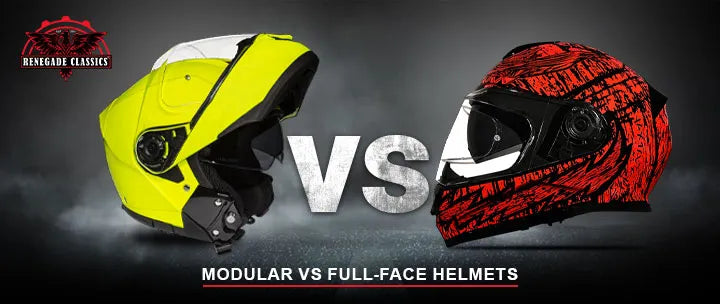
A full-face helmet has a fixed chin bar. A modular helmet has a chin bar that flips up, so you can talk, drink, or put on glasses without taking the helmet off. Both kinds are sold with DOT certification, and many also carry the European ECE rating. The real difference is whether a modular’s chin bar is certified to protect you, and whether you can ride with it open. This guide covers safety ratings, weight, noise, and price, with real examples from our modular motorcycle helmets and full-face helmets.
What Is a Modular Motorcycle Helmet?

A modular helmet, also called a flip-up helmet, has a chin bar and face shield that lift up on a hinge. When it’s closed, it looks and works like a full-face helmet. When it’s open, it’s closer to an open-face helmet. Most modulars also have a drop-down sun visor.
History of Modular Helmets
BMW is generally credited with the first mass-produced flip-up helmet, its System helmet from the early 1980s. Touring riders took to it because they could stop for fuel or directions without pulling the helmet off.
Advantages of Modular Helmets
- Flip the chin bar up to talk, drink, or pay at a fuel stop
- Easier to put on and take off, especially with glasses. The HJC C91 has grooves built in for glasses
- Most have a built-in sun visor
- P/J-rated models can be ridden open at low speed.
Disadvantages of Modular Helmets
- Usually a few hundred grams heavier than a similar full-face helmet, because of the hinge
- Bulkier around the jaw
- The seam around the chin bar can let in more wind noise
- The chin bar is only certified to protect you if the helmet is P-rated. If it’s J-only, treat it like an open-face helmet
What Is a Full Face Helmet?

A full-face helmet is designed to cover the user's entire head, including chin and face. They provide the best level of protection. They are great for all types of riding.
History of Full-Face Helmets
The Bell Star, released in 1966, is widely seen as the first full-face helmet sold to the public. Racers adopted it first, and street riders followed through the 1970s.
Advantages of Full-Face Helmets
- A one-piece shell with no hinge, which is the strongest design
- Usually lighter and quieter than a modular
- A wider choice of styles, from track helmets to retro designs like the Daytona Retro ($149.95)
- Lower starting prices. The HJC C10 is $129.74
Disadvantages of Full-Face Helmets
- You have to take it off to eat, drink, or have a face-to-face conversation
- Harder to put on over glasses
- Warmer in summer traffic
Modular vs Full Face Helmet: Side-by-Side
Safety and comfort depend on the modular and full-face helmets' features. They provide their own advantages for different riders. This quick comparison helps you understand which one suits your needs best.
|
Full Face Helmets |
Modular Helmets |
|
|
Chin bar |
Fixed, part of the shell |
Hinged, flips up |
|
Certifications |
Some DOT, ECE 22.06, and Snell |
Some DOT, ECE 22.06 (look for P/J) |
|
Can you ride it open? |
No |
Yes |
|
Weight |
Lighter compared to modular |
A few hundred grams heavier |
|
Noise |
Usually quieter |
Noisier than full-face |
|
Glasses |
Harder to fit |
Easy |
|
Our price range |
From $129.74 to $1934.75 |
From $199.95 to $899.95 |
Are Modular Helmets as Safe as Full-Face Helmets?
A modular can match a full-face helmet in a crash, but only when the chin bar is locked and certified. Here’s how to check.
DOT (FMVSS 218) is the US legal minimum. It tests impact and penetration on the top and sides of the helmet. It doesn’t test chin bars on any helmet, modular or full face.
ECE 22.06 is the European standard, and it does test chin bars. Modulars carry a rating code:
- P (protective): the chin bar passed impact tests in the closed position
- J (jet): the chin bar isn’t certified, so treat it like an open-face helmet
- P/J: certified closed, and also approved for riding open
Not every modular helmet carries an ECE rating, so check the product page before you buy. In our range, the Daytona C6 PRO, Daytona C6, Daytona Legacy, and LS2 Advant are certified to both DOT and ECE. The C6 PRO and Advant meet the current ECE 22.06 standard. The C6 PRO Forged also has a P/J rating and locks its chin bar at 90 degrees when it’s open. Helmets marked DOT only, such as the Daytona Glide, meet the US legal standard, but their chin bars haven’t been tested.
The bottom line: a P-rated modular, ridden closed, gives protection close to a full-face helmet. A full-face helmet is still the strongest choice for fast riding, because it has no hinge that could fail.
Can You Ride With a Modular Helmet Open?
Only if it’s P/J rated. Even then, ride open only at low speed, such as in parking lots or stop-and-go traffic. A flipped-up chin bar catches the wind at highway speed and leaves your face unprotected. If the product page doesn’t list a P/J rating, ride with the chin bar closed.
Which Should You Choose?
There is no one-size-fits-all answer. It depends on the rider's requirements
Touring Riders
Modular helmets are ideal for touring. You can flip up the chin bar during breaks, such as the Daytona Glide ($199.95), a DOT-certified modular that’s Bluetooth-ready with dual visors.
City Commuters
Modular helmets make city stops easier. Short rides benefit from the convenience of flip-up motorcycle helmets such as the LS2 Strobe II ($199.99, DOT and ECE 22.05).
Long-Distance Highway Riding
Full-face helmets provide better wind protection and reduced noise. Perfect for high-speed long trips such as the HJC C71 ($199.74).
Adventure Riders
Most adventure riders choose a dual-sport helmet, with a peak to block the sun and a wide eyeport for goggles. If you mostly ride paved roads with occasional gravel, a P/J-rated modular works for touring.
Go for a modular helmet if convenience and versatility matter. And if maximum safety and aerodynamics are your priority, then go for a certified full-face helmet.
FAQs
Are modular helmets less safe than full-face?
Not if the chin bar is ECE P-rated, and you ride with it closed. A DOT-only modular passes US impact tests, but its chin bar has not been tested. A full-face helmet has no hinge, so it’s still the strongest option.
Are modular helmets bigger than full-face helmets?
Slightly. The hinge adds bulk around the jaw and a few hundred grams of weight. The Daytona C6 PRO, Daytona’s lightest modular, weighs between 3.20- 3.52 lb and comes in three shell sizes to keep it in proportion. The LS2 Strobe II weighs about 1,550 g and the LS2 Advant about 1,650 g, according to their product pages.
Are full-face helmets quieter than modular?
Yes. A full-face shell has no seam at the chin bar, where wind gets in. Noise depends more on fit and design than on helmet type.
What does P/J mean on a modular helmet?
It’s an ECE rating. It means the helmet passed tests with the chin bar closed and is also approved for riding open.
Find Your Helmet
Choose a full-face helmet if you ride fast or want the strongest shell. Choose a P/J-rated modular if you tour, wear glasses, or stop often. Browse our modular motorcycle helmets, full-face helmets, or all motorcycle helmets.


