

Key Takeaways
- Sleeveless flannel shirts are a legitimate and widely worn summer riding option for Harley and cruiser riders. They are not a safety compromise if you understand what they provide and what they do not.
- A sleeveless flannel provides torso coverage, the biker flannel identity, and a back panel for patches. It does not provide arm coverage, elbow protection, or arm abrasion resistance in a fall.
- The trade-off is straightforward: maximum arm ventilation in exchange for arm protection. For casual riding, events, and lower-speed urban riding in summer heat, this trade-off is widely accepted in the riding community.
- Armored sleeveless flannel options exist with CE armor at the shoulders and a back pocket for an optional back protector. These provide impact protection at the shoulder zones without arm coverage.
- Under a leather vest, the sleeveless flannel is one of the most common summer riding setups in the Harley and cruiser community. The vest covers the torso. The flannel provides the back panel for patches and the cultural identity layer.
- For regular highway riding at sustained speeds where arm protection matters more, a short sleeve or full sleeve option provides more comprehensive coverage.
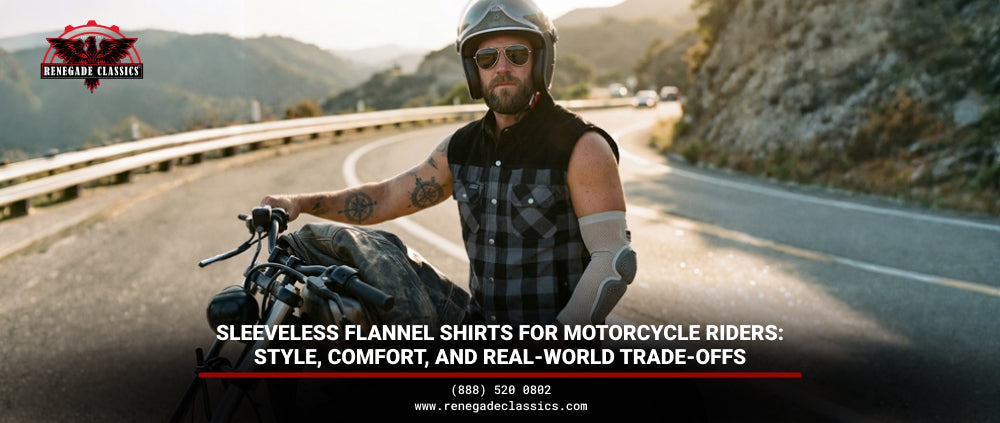
Sleeveless flannel shirts for motorcycle riders are one of the most practical and culturally embedded summer riding choices in the Harley and cruiser community. They solve the summer heat problem in a way that fits biker culture identity without requiring a departure from the flannel aesthetic that defines the riding wardrobe.
This guide covers what a sleeveless riding flannel provides, the honest protection trade-offs every rider should understand before choosing one, when it makes sense and when it does not, and how riders in the Harley community actually use them.
For the full summer riding shirt guide covering all cuts and types, see the hot weather motorcycle shirts guide.
What a Sleeveless Flannel Shirt Is for Motorcycle Riders
A sleeveless flannel shirt for motorcycle riding is exactly what it sounds like: a flannel shirt with the sleeves removed or designed without sleeves from the start. The key difference from a standard graphic tee or tank top is the flannel construction: heavier fabric, snap closures, reinforced seams, and in riding-specific versions, a back panel for patch display and armor pockets at the shoulders.
In the Harley and cruiser riding community, the sleeveless flannel has a specific and well-established role. It serves as the shirt layer worn under a leather vest in summer heat, providing:
- The visual texture and weight of a flannel at the torso and front.
- A solid back panel that supports patch display, often the primary function for riders in clubs or with significant patch collections.
- The cultural identity of flannel riding culture without the arm heat of a long sleeve.
- Snap closures that hold the shirt in place at riding speed.
It is not a tee shirt with flannel fabric. It is a flannel shirt designed for summer use, with everything a full sleeve flannel provides at the torso and nothing at the arms.
The Real-World Trade-Offs: What You Gain and What You Give Up
What You Gain
Choosing a sleeveless flannel over a full sleeve option provides specific and meaningful benefits for summer riding:
- Maximum arm ventilation: Removing the sleeves eliminates the fabric that traps heat around the arms. At riding speed, this allows direct airflow across the full arm surface. In genuine summer heat, this is the most significant heat reduction available within the flannel shirt category.
- Flannel identity without flannel heat: The sleeveless cut retains the flannel aesthetic at the chest and back where it is most visible, particularly when wearing a leather vest. The absence of sleeves is largely hidden under the vest in this combination.
- Back panel for patches: The sleeveless flannel provides a structured back panel that supports patch display in a way that a tee shirt does not. For riders who carry significant patches, this is often the primary reason to choose a sleeveless flannel over a graphic tee in summer.
- Comfort at stops: At a standstill in summer traffic, the lack of sleeve fabric significantly reduces heat buildup compared to a full long sleeve flannel. The stop-and-go problem that makes long sleeve flannels uncomfortable in summer heat is less severe in a sleeveless option.
What You Give Up
The trade-off for choosing a sleeveless flannel must be clearly understood before making the choice:
- Arm abrasion resistance: A sleeveless flannel provides no fabric protection for the arms in a fall. The arms are exposed to road contact if you go down. Cotton flannel provides limited abrasion resistance even when present. Removing it entirely eliminates what limited protection it offered.
- Elbow protection: No sleeve means no elbow armor pocket. CE-certified elbow armor cannot be incorporated in a sleeveless cut. If elbow protection matters for your riding, you need at least a short sleeve option.
- Sun protection: Bare arms are exposed to direct sun. On long summer rides, this means more sunscreen required and more sun exposure at sustained speeds. For riders who burn easily or ride for extended periods, this is a practical consideration alongside the protection trade-off.
- Wind blocking at the arms: In cooler conditions or at higher speeds, bare arms experience more wind exposure than sleeved arms. What feels refreshing in Texas summer heat can feel cold on an early morning ride or at higher elevations.
When a Sleeveless Flannel Makes Sense
Summer Events and Rallies
The sleeveless flannel is most appropriate and most widely used at summer events and rallies. In this context, the rider is typically moving at lower speeds, standing around in the heat, and wanting to look right in the biker culture context without overheating.
At an event like Sturgis in August or a summer charity ride in Texas heat, the sleeveless flannel under a leather vest is the standard summer biker outfit. The vest covers the torso. The flannel provides the back panel and identity. The bare arms allow heat to escape. This combination has been a widely used summer setup in the Harley and cruiser community for decades.
Urban and Low-Speed Riding in Heat
For urban commuting and low-speed riding in summer heat, the sleeveless flannel reduces heat discomfort significantly compared to any sleeve option. At lower speeds where wind chill from airflow is less significant, the absence of sleeve fabric makes a meaningful difference in how hot the rider feels.
For riders who commute in city traffic in summer and prioritize comfort over arm protection at those riding speeds and distances, the sleeveless flannel is a practical choice.
Layering Under a Leather Vest
The vest combination is where the sleeveless flannel makes the most sense structurally. When the leather vest is worn over the top:
- The vest covers the entire torso and front of the flannel.
- Only the back panel of the flannel is fully visible below the vest bottom edge.
- The arms are bare but the primary visual layer of the outfit is the vest.
- The flannel provides the patch backing, snap closure identity, and texture that a plain tee shirt does not.
In this combination, the sleeveless flannel is doing a different job from a full sleeve flannel. It is not trying to be the primary shirt layer. It is supporting the vest as the anchor of the riding outfit while managing heat at the arms.
When a Sleeveless Flannel Is Not the Right Choice
The honest picture of the sleeveless flannel includes the riding contexts where it is not appropriate:
- Regular highway riding at sustained speed: At highway speeds where a fall is more consequential, arm protection matters more than in casual or low-speed riding. A short sleeve or full sleeve option provides more coverage without the full heat burden of a heavy winter flannel.
- Riding in cooler conditions: Bare arms in temperatures below 65 to 70 degrees become uncomfortable at speed. The sleeveless flannel is a summer-specific choice. When temperatures drop, the full sleeve flannel is the appropriate option.
- Riders who want elbow armor: If CE elbow protection is a priority, a sleeveless flannel cannot provide it. The sleeve must reach the elbow joint for armor to be correctly positioned. Choose a short sleeve or full sleeve armored flannel if elbow protection matters.
- Extended rides with significant sun exposure: On long summer rides where sun exposure accumulates over several hours, bare arms require consistent sun protection. A short sleeve option provides some coverage while still managing heat better than a full long sleeve.
Armored Sleeveless Flannel Options
Armored sleeveless flannels are available in the riding market. They provide CE armor at the shoulder zones and an optional back pocket for a back protector, while retaining the sleeveless cut for summer heat management.
What armored sleeveless flannels provide:
- CE Level 1 shoulder armor at the shoulder joints. This provides impact protection at one of the most important joint zones for armored riding gear.
- An optional back armor pocket for a CE-certified back protector. Back armor is typically sold separately and inserted through an interior pocket.
- The same heat management benefit as any sleeveless cut at the arms.
What they do not provide:
- Elbow armor. The sleeveless cut cannot position elbow armor correctly.
- Arm abrasion resistance. The arms remain unprotected from road contact in a slide.
For riders who want maximum summer heat management with meaningful shoulder protection, an armored sleeveless flannel is the best available option within the sleeveless category. For riders who need elbow protection, the short sleeve armored option is the appropriate choice instead.
Browse armored flannel shirts at Renegade Classics for armored flannel options across sleeveless and full sleeve cuts.
How to Style a Sleeveless Flannel for Motorcycle Riding
The Classic Vest Combination
The standard sleeveless flannel outfit for the Harley and cruiser rider:
- Sleeveless flannel as the shirt layer. Snapped or partially open depending on temperature and preference.
- Leather vest over the top. The vest anchors the riding identity and covers the torso.
- Jeans or riding pants and boots.
In this combination, the flannel is largely hidden under the vest at the torso. The back panel is visible below the vest and is where patches are typically displayed. The bare arms and the flannel texture at the neckline are the only fully visible flannel elements at the front.
This outfit is the standard summer biker setup. It requires no styling effort beyond the flannel and vest selection. The combination is culturally correct for any Harley riding context from a casual ride to a major rally.
At a Rally or Event
At events and rallies, the sleeveless flannel can also be worn without the vest in very hot conditions. Worn on its own over a plain tee or worn as the primary visible layer, the sleeveless flannel reads as a deliberate style choice rather than casual wear.
The snap closure construction and heavier flannel fabric distinguish a sleeveless riding flannel from a standard tank top or tee shirt. In a biker culture context, this distinction is recognized. A quality sleeveless riding flannel communicates riding identity even without a vest over it.
Off the Bike
The sleeveless flannel transitions naturally to off-bike wear in summer. Over a plain tee at a bar, at a casual outdoor setting, or as a layer in warm weather, the sleeveless flannel reads as workwear-influenced casual style. It does not look like riding gear off the bike. It looks like a deliberate choice by someone who knows what they are wearing.
Sleeveless Flannel vs Short Sleeve vs Long Sleeve: A Direct Comparison
For riders deciding between the three sleeve length options for summer:
- Sleeveless: Maximum ventilation, no arm coverage, no elbow armor possible. Best for events, rallies, and casual low-speed riding in genuine summer heat. The choice when staying cool is the priority and arm coverage is accepted as the trade-off.
- Short sleeve: Moderate ventilation, upper arm coverage, elbow armor possible if sleeve reaches the elbow. The middle ground. Better heat management than long sleeve, more coverage than sleeveless. Best for moderate summer temperatures and riders who want some arm coverage.
- Long sleeve: Full arm coverage, elbow and shoulder armor, more comprehensive protection. More heat than either shorter option. Best for highway riding and cooler temperatures where the protection benefit justifies the heat.
For the full comparison of sleeve length options and how to choose, see the best short sleeve biker shirts for summer guide.
Fit and Sizing for Sleeveless Flannels
Fit considerations for a sleeveless flannel differ from a full sleeve option:
- Armhole size: The armhole opening should allow comfortable full arm movement without binding. Too tight an armhole restricts movement and can dig into the armpit during riding. Try the shirt in a forward-lean position with arms extended to verify the armhole does not restrict reach.
- Back length: The back hem should sit at or below the waistband in a riding position. A back that rides up exposes the lower back and undermines the patch display function if the patches are near the hem.
- Shoulder fit: The shoulder seam should sit at the actual shoulder point. A shoulder seam that drops off the shoulder indicates the shirt is too large. A shoulder seam that pulls toward the neck indicates it is too small.
- Torso width: Without sleeves, the torso fit is even more visible than in a full sleeve shirt. Size for a fit that sits cleanly without pulling across the chest or billowing at the sides.
What to Read Next
- Hot weather motorcycle shirts guide covers the complete summer riding shirt category for the Harley and cruiser rider, including all shirt types and the full summer outfit setup.
-
Men's sleeveless denim shirts guide covers the sleeveless denim option specifically, which provides similar summer benefits to the sleeveless flannel with a denim aesthetic.
-
Best short sleeve biker shirts for summer guide covers the short sleeve option for riders who want arm coverage with less heat than a full sleeve.
- Sleeveless or long sleeve guide covers the full decision framework for choosing between sleeve length options based on riding style and climate.
The Bottom Line
Sleeveless flannel shirts for motorcycle riders are a legitimate, practical, and culturally grounded summer riding choice. They are not a safety compromise if you understand the trade-off clearly. Arm coverage and elbow protection are given up in exchange for maximum arm ventilation and heat management.
For events, rallies, casual riding, and urban summer commuting where this trade-off is appropriate, the sleeveless flannel under a leather vest is the summer riding outfit the Harley and cruiser community has relied on for generations. For highway riding at sustained speed where arm coverage matters more, the short sleeve or full sleeve option is the better choice.
Browse sleeveless flannels at Renegade Classics for the full range of sleeveless riding flannel options.
Frequently Asked Questions
Is a sleeveless flannel safe for motorcycle riding?
A sleeveless flannel is appropriate for casual riding, events, and lower-speed urban riding where the rider understands and accepts the arm coverage trade-off. It does not provide arm or elbow protection in a fall. For these riding contexts, it is a widely used and practically comfortable choice. For regular highway riding at sustained speeds where a fall is more consequential, a short sleeve or full sleeve option provides more comprehensive arm coverage.
What protection does a sleeveless flannel provide?
A standard sleeveless flannel provides torso coverage and the structure of the flannel shirt at the chest, back, and torso. It does not provide arm coverage, elbow protection, or arm abrasion resistance. An armored sleeveless flannel adds CE shoulder armor and an optional back protector pocket, which provides impact protection at the shoulder zones and optionally the spine, while the arms remain uncovered.
Can I get a sleeveless flannel with CE armor?
Yes. Armored sleeveless flannels are available with CE shoulder armor and an optional back armor pocket. These provide CE-certified impact protection at the shoulder joints and optionally the spine while retaining the sleeveless cut for summer heat management. Elbow armor cannot be incorporated in a sleeveless cut because there is no sleeve to position the armor pocket over the elbow joint.
Is a sleeveless flannel or a short sleeve better for summer riding?
For maximum heat management in genuine summer heat, the sleeveless option is cooler. For riders who want some arm coverage without the full heat of a long sleeve, the short sleeve is the better balance. The right choice depends on your riding conditions and how you weigh heat comfort against arm coverage. Many riders own both and choose based on the specific ride, temperature, and context.
How do I wear a sleeveless flannel under a leather vest?
Put on the sleeveless flannel first, snapping or leaving the front open based on your preference and temperature. Then put the leather vest over the top. The vest covers the torso and front of the flannel. The flannel back panel should sit flat under the vest with patches visible below the vest bottom edge. Adjust the flannel so the back hem sits at or below the waistband in your riding position. The combination is comfortable, culturally correct, and the standard summer riding setup for Harley and cruiser riders.


