

Key Takeaways
-
The best armored motorcycle flannel shirts combine abrasion-resistant materials like Kevlar, aramid fibers, or Dyneema with CE-rated impact armor and reinforced stitching.
-
Kevlar lining and CE armor solve different problems. Kevlar resists abrasion in a slide. CE armor absorbs and distributes impact force at the joints. The strongest armored flannels include both.
-
CE Level 1 is the baseline certification for motorcycle armor. CE Level 2 absorbs more impact force and is better suited to higher-speed riding.
-
Always verify CE certification on the armor insert itself, not just the hang tag. Remove the insert and check for a label showing the CE level.
-
An armored flannel is not a direct replacement for a motorcycle jacket. It provides meaningful protection for everyday and urban riding but does not match a jacket's full surface coverage.
-
Size an armored flannel for the riding position. Armor pockets must sit over the correct joints when you are leaning forward on the bike, not just when standing.
The best armored motorcycle flannel shirts offer casual everyday style while hiding genuine impact protection underneath. They look like a regular flannel from the outside. Inside, they carry abrasion-resistant lining and CE-certified armor that makes a real difference in a fall.
This guide covers what armored motorcycle flannels actually protect against, how the protection hierarchy works from Kevlar-only to CE Level 2, how to verify the armor is real, and what to look for at each price and protection level. It applies specifically to the Harley, cruiser, and biker culture rider who wants meaningful protection in a shirt that fits the riding identity.
For the full safety picture on what armored flannels can and cannot do, see the motorcycle flannel safety guide.
What Makes an Armored Flannel Different from a Regular Flannel
A regular motorcycle flannel is heavier than a retail flannel and built with reinforced seams. That is where the protection ends. An armored motorcycle flannel adds two protective layers that a standard flannel does not have.
-
Abrasion-resistant lining: Panels of Kevlar or other aramid fiber materials, and in some garments Dyneema (a high-performance polyethylene fiber), are sewn into the interior of the shirt at high-impact zones. These fibers resist tearing in a slide and protect the skin underneath from road contact.
-
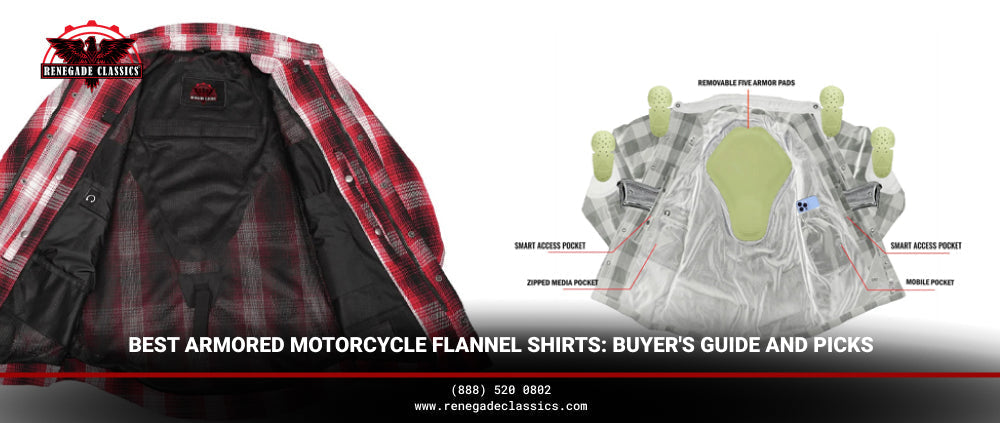
CE-certified impact armor: Hard or semi-rigid armor inserts sit in dedicated pockets at the shoulders, elbows, and optionally the back. These inserts are independently tested to absorb and distribute impact force at the points that take the hardest hits in a fall.
The combination of both features in a single garment is what makes a quality armored flannel a legitimate piece of protective riding gear rather than just a styled shirt.
The Protection Hierarchy: Four Levels of Armored Flannel
Not all armored flannels provide the same level of protection. Understanding the four levels helps you choose the right option for your riding.
Level 1: Standard Flannel with No Armor
Heavier fabric and reinforced seams only. No abrasion-resistant lining, no CE armor. This is a riding-aesthetic shirt, not protective gear. Suitable for events, rallies, and low-speed urban riding where the rider accepts the protection trade-off.
Level 2: Kevlar or Dyneema-Lined Flannel
Aramid fiber panels sewn into the interior at the shoulders, elbows, and sometimes the back. No CE-certified impact armor. Provides meaningful abrasion resistance in a slide but does not absorb impact force the way CE armor does. A good mid-point between style and protection for riders who want more than a standard flannel but do not require full CE armor.
Level 3: CE Level 1 Armored Flannel
CE Level 1 armor inserts at the shoulders, elbows, and optionally the back. The inserts have been independently tested to absorb and distribute impact energy to the CE Level 1 standard. This is the baseline for genuine motorcycle protective gear certification. A CE Level 1 armored flannel is suitable for everyday riding including urban commuting and moderate-speed roads.
Level 4: CE Level 2 Armored Flannel
CE Level 2 armor inserts meet a stricter impact absorption standard than Level 1. The tested force threshold is significantly higher. CE Level 2 is better suited to higher-speed riding, regular highway commuting, and riders who want the maximum protection the flannel category can provide. CE Level 2 armored flannels are typically in the higher price range of the category.
For a detailed explanation of what the tested difference between the two levels means in practical terms, the CE Level 1 vs CE Level 2 armor guide covers each level with guidance on which suits which riding style.
Best for Everyday Riding: CE Level 1 Armored Flannel
For most riders who want genuine protection in a flannel for regular road use, a CE Level 1 armored flannel is the practical starting point. It provides certified impact protection at the key zones, looks identical to a standard flannel, and is available across a wide price range.
What to look for:
-
CE Level 1 certification on the shoulder and elbow inserts. Verify on the insert label, not just the hang tag.
-
Removable inserts so the flannel can be washed without damage to the armor.
-
Aramid lining at the shoulders and elbows at minimum, full-coverage lining preferred.
-
Armor pockets with dedicated closures that keep the insert positioned over the joint.
-
Fit that does not restrict shoulder movement in a forward lean riding position.
Browse armored flannel shirts at Renegade Classics for CE-certified options built for the Harley and cruiser rider.
Best for Maximum Protection: CE Level 2 Armored Flannel
Riders who commute regularly on highways, cover long distances, or simply want the strongest protection the flannel category offers should look for CE Level 2 armor inserts.
CE Level 2 flannels are less common than Level 1 options and typically cost more. The protection difference is real and worth the investment for riders who are on the bike daily or at higher speeds regularly.
What to look for beyond the Level 1 checklist:
-
Explicit CE Level 2 designation on the armor insert label. Level 2 must be stated clearly. Do not assume Level 2 based on price alone.
-
Back armor pocket. CE Level 2 protection is most valuable when it covers the back as well as the shoulders and elbows.
-
Full-coverage Kevlar, aramid, or Dyneema lining combined with the Level 2 inserts for the strongest combined protection profile in the flannel category.
Best for Hot Weather: Armored Sleeveless or Lightweight Short Sleeve
Summer riding creates a conflict for armored flannel riders. A full long sleeve armored flannel is too warm in high heat. The options for armored protection in summer are more limited but they exist.
Armored sleeveless flannels provide shoulder and back armor without sleeve fabric. The elbow zone is unprotected in a sleeveless cut. This is a protection trade-off worth understanding before choosing this option for higher-speed riding.
For summer armored riding options, what to look for:
-
CE Level 1 shoulder armor at minimum in a sleeveless cut.
-
Back armor pocket for spine protection even without sleeve coverage.
-
Lighter fabric weight that does not trap heat against the torso.
-
Aramid lining at the shoulder zones even without elbow coverage.
The honest trade-off in a sleeveless armored flannel: you gain ventilation and lose elbow protection. For riders who accept that trade-off, this is the most practical armored option for genuine summer heat.
Best Full-Coverage Option: Abrasion-Lined and CE-Armored Combined
The strongest protection profile in the armored flannel category combines full-coverage abrasion-resistant lining such as Kevlar or Dyneema with CE-certified armor inserts. The lining handles abrasion across the full garment surface. The inserts handle impact at the key joints.
This combination addresses both injury types in a motorcycle fall: road rash from sliding contact with the surface, and impact injuries at the joints from the initial impact.
What this combination looks like in a garment:
-
Abrasion-resistant fabric such as Kevlar or Dyneema running through the full interior of the shirt, not just patch panels at joints.
-
CE-certified armor inserts at the shoulders and elbows, with a back pocket for an optional back protector.
-
Reinforced stitching at all seams, particularly the shoulder and underarm stress points.
-
Heavy-duty snap closures and extended back hem for riding-position coverage.
This is typically the highest price point in the armored flannel category. For riders who ride regularly and want the best the category offers, it is the right investment.
For context on why Kevlar demand has grown in the riding community and what full-coverage lining actually provides, the Kevlar flannel demand guide covers the material science in plain terms.
How to Verify the Armor Is Actually CE-Certified
The hang tag on a flannel shirt can say many things about protection. The only source that confirms CE certification is the label on the armor insert itself.
How to verify:
-
Open the armor pocket and remove the insert.
-
Look for a label on the insert. A CE-certified insert will show the CE mark and state the level: Level 1 or Level 2.
-
If the insert has no label, or if the label says only "padded" or "protective" without a CE level designation, it has not been CE-certified.
-
Do not rely on marketing language on the hang tag, product description, or packaging. Check the insert.
This is the single most important check before buying any armored flannel. Uncertified padding is widely used in lower-priced garments and is sometimes marketed with CE-adjacent language that implies certification without confirming it.
How to Size an Armored Flannel Correctly
Sizing an armored flannel correctly is different from sizing a regular shirt. The armor pockets must sit over the correct joints in a riding position, not just when standing.
The sizing check for an armored flannel:
-
Put the flannel on with any base layer you plan to wear underneath.
-
Sit in a forward riding position with arms extended as if holding handlebars.
-
Open the shoulder armor pocket and confirm the insert is seated correctly over the shoulder joint area.
-
Open the elbow armor pocket and confirm the insert is seated at the elbow point, not shifted above or below it.
-
Check that the back hem stays at your waistband and does not ride up in the riding position.
If the armor has shifted off the target joint in a riding position, the garment is not sized correctly for you regardless of how the chest measurement compares to the size chart.
For full sizing guidance across armored riding gear, see the armored gear sizing guide.
Armored Flannel vs Motorcycle Jacket: The Honest Comparison
An armored flannel is not a motorcycle jacket. It provides real protection that is meaningfully better than riding unarmored. It does not provide the same protection as a dedicated motorcycle jacket. Both statements are true.
Where an armored flannel is a practical choice:
-
Urban and lower-speed commuting where the rider accepts the protection trade-off for daily wearability.
-
Casual riding and events where a jacket would be too warm or too formal for the context.
-
Layering under a leather vest where the vest adds an outer abrasion layer over the flannel.
-
Riders who will actually wear the flannel consistently versus a jacket that stays home because it is too heavy or too hot.
Where a motorcycle jacket provides more:
-
Full outer surface abrasion resistance across the chest, back, and arms.
-
Heavier outer materials that provide more barrier against road contact in a slide.
-
Weather protection that a flannel does not provide.
-
Higher-speed riding where the consequences of a slide are more severe.
The honest position: a jacket left at home provides no protection at all. For the biker culture rider who values wearability and will actually wear the flannel on every ride, consistent use of an armored flannel is a practical choice. This is a wearability argument, not a claim that a flannel out-protects a jacket.
For the full comparison of what each garment type provides in a crash scenario, the motorcycle jacket vs armored shirt comparison covers each scenario in detail.
What to Read Next
Motorcycle flannel safety guide covers what armored flannels protect against and where their limits are, with an honest breakdown by riding speed and scenario.
CE Level 1 vs CE Level 2 armor guide explains the practical tested difference between the two certification levels and which suits which type of riding.
Motorcycle jacket vs armored shirt comparison gives an honest side-by-side of what each garment provides and where each one is the better choice.
Armored gear sizing guide covers the full sizing process for armored riding garments including the seated riding position check that standard size charts do not account for.
Kevlar flannel demand guide explains why aramid fiber lining has become a standard feature in quality armored flannels and what full-coverage lining actually provides.
Motorcycle flannel buying guide covers every feature to check before buying any motorcycle flannel, from fabric weight and seam construction to fit for riding posture.
The Bottom Line
The best armored motorcycle flannel shirts combine abrasion-resistant lining with CE-certified impact armor in a garment that looks and feels like a regular riding flannel. The protection is real when the armor is genuinely CE-certified and the garment is sized correctly for a riding position.
Choose CE Level 1 for everyday riding. Choose CE Level 2 for regular highway use. Add full abrasion-resistant lining if you want the strongest protection the category offers. Always verify the CE level on the insert itself before buying.
Browse the full range of armored flannel shirts at Renegade Classics for CE-certified options built for the Harley and cruiser rider.
Frequently Asked Questions
Are flannel shirts good for motorcycle riding?
Motorcycle-specific flannel shirts are a legitimate riding option. Standard retail flannels are not. The difference is in the construction: motorcycle flannels use heavier fabric, reinforced seams, and in armored versions, CE-certified armor inserts and abrasion-resistant lining. A fashion flannel provides none of these features. An armored motorcycle flannel provides meaningful protection for everyday riding.
What is the difference between Kevlar lining and CE armor in a flannel?
Kevlar and other aramid fiber linings provide abrasion resistance. They resist tearing when the fabric slides against road surface. CE armor inserts provide impact protection. They absorb and distribute the force of an impact at the joints. Both address different injury types. Abrasion lining protects against road rash. CE armor protects against joint impact injuries. The strongest armored flannels include both.
Do I need CE Level 1 or CE Level 2 armor in my flannel?
CE Level 1 is appropriate for everyday riding, urban commuting, and moderate-speed roads. CE Level 2 is better suited to regular highway riding, higher-speed commuting, or riders who want the maximum protection the flannel category provides. Level 2 absorbs significantly more impact force in testing. The right choice depends on how and where you ride most often.
Can an armored flannel replace a motorcycle jacket?
An armored flannel provides genuine protection that is meaningfully better than riding unarmored. It does not replace a motorcycle jacket in terms of full surface abrasion coverage or weather protection. For urban and casual riding, a well-fitted CE Level 2 armored flannel is a practical and protective choice. For sustained highway riding at higher speeds, a dedicated motorcycle jacket provides more comprehensive protection.
How do I know if my armored flannel has real CE armor?
Remove the armor insert from the pocket and look for a label on the insert itself. A genuine CE-certified insert will have the CE mark and show either Level 1 or Level 2. If the insert has no label or shows only general terms like "padded" or "protective" without a CE level designation, it has not been CE-certified. Marketing language on the hang tag or product page does not confirm certification. Only the insert label does.


