

Key Takeaways
- Kevlar flannels are in demand because they solve a problem the traditional riding gear market did not fully address: protection that looks and wears like casual biker clothing rather than safety equipment.
- Kevlar is the most recognized brand name for para-aramid fiber in the motorcycle market, but other aramid fibers serve the same abrasion resistance function. "Kevlar flannel" has become the general market term for any aramid-lined riding flannel.
- The demand comes from riders who want CE-certified protection in a garment that fits their riding identity and can be worn on and off the bike without looking like gear.
- The four specific properties driving demand are: abrasion resistance without bulk, plain clothes aesthetics, CE armor integration, and comfort in warm weather conditions where a leather jacket is impractical.
- Demand is strongest in the Harley and cruiser market where riding identity is expressed through clothing and where a garment that looks like casual wear has more cultural credibility than technical riding gear.
- Quality varies significantly across the Kevlar flannel market. The term is used broadly and not all products described as Kevlar flannels provide equivalent protection.
Why Kevlar flannels are in demand in the biking industry is a question that reflects a broader shift in how riders think about protective gear. For decades, motorcycle protection meant wearing gear that looked like protection: leather jackets, riding suits, high-visibility vests. For the Harley and cruiser rider, that approach has always created tension with the cultural identity that is expressed through what they wear.
The Kevlar flannel category resolves that tension by putting genuine protective materials inside a garment that looks and wears like a biker flannel. This guide explains what drives that demand and what the category actually delivers.
For the full buyer's guide to armored flannel shirts, see the armored flannel buying guide.
What "Kevlar Flannel" Actually Means
Kevlar is a registered trademark of DuPont for their para-aramid synthetic fiber. It is one of the most recognized brand names in the motorcycle protective gear market. In common usage, "Kevlar flannel" has become the general term for any motorcycle flannel shirt that incorporates aramid fiber lining for abrasion resistance, whether that aramid fiber is branded Kevlar or another manufacturer's equivalent.
The aramid fiber category includes several branded and unbranded options that provide comparable abrasion resistance properties, though construction quality and fiber specifications can vary between products:
- Kevlar: DuPont's para-aramid fiber, the most recognized name in the market.
- Twaron: Teijin's para-aramid fiber, used in many motorcycle protective garments.
- Generic aramid fiber: Unbranded para-aramid fiber used in many riding garments at accessible price points.
All of these are para-aramid fibers with high strength-to-weight ratios and significant abrasion resistance compared to standard cotton or polyester fabrics. When a product is described as a "Kevlar flannel," verify what specific aramid material is used. The marketing term does not guarantee a specific fiber brand or construction quality.
The Four Reasons Demand Is Growing
Protection Without Bulk
The traditional riding protection market served riders who accepted that protective gear would be heavier, stiffer, and more restrictive than casual clothing. Leather jackets, textile riding suits, and armored gear all provide significant protection at the cost of weight, bulk, and restricted movement compared to casual wear.
The Kevlar flannel addresses this trade-off by integrating protective materials into a garment construction that retains the weight, drape, and movement of a flannel shirt. Aramid fiber is substantially stronger than cotton per unit weight. A flannel shirt with aramid lining at the key abrasion zones provides meaningful protection with minimal addition to the garment weight or stiffness.
For the rider who finds a full leather jacket impractical for daily commuting, event attendance, or warm weather riding, the Kevlar flannel provides protection in a format that does not create the same practical barriers to consistent wear.
The Plain Clothes Advantage
The biker culture rider has specific identity requirements for their clothing. A flannel shirt, a leather vest, jeans, and boots communicate a specific cultural identity in the riding community. Technical riding gear with high-visibility panels, built-in aerodynamic features, and sport motorcycle styling does not.
A Kevlar flannel looks like a flannel shirt. From the outside, there is no visible indicator that it contains aramid lining and CE armor pockets. It reads as casual biker clothing in every context where the rider wears it, from the saddle to a bar to a casual meal after a ride.
This plain clothes advantage is not cosmetic. It directly affects how consistently the protection is worn. Gear that disrupts the rider's cultural identity or creates social friction in off-bike contexts gets worn less consistently. A flannel that provides the same identity signal as any other flannel gets worn on every ride without the friction.
CE Armor Integration
The addition of CE-certified armor pockets to the Kevlar flannel design addresses the impact protection gap that aramid lining alone does not cover. Aramid fiber provides abrasion resistance. CE-certified armor absorbs and distributes impact force at the joints. A flannel with both features addresses both major injury mechanisms from a fall.
For riders who previously chose between a fashion flannel that provided no protection and a full motorcycle jacket that provided comprehensive but impractical protection, the CE-armored Kevlar flannel represents a meaningful middle option. It is not the maximum protection available. It provides genuine certified protection in a format that suits the biker riding wardrobe.
The Comfort Gap Between Jackets and Flannels
In summer heat and mild weather conditions, a full leather or textile motorcycle jacket becomes uncomfortable enough that many riders choose not to wear it. This comfort gap creates a genuine safety problem: riders in the conditions where they are most likely to ride casually and wear less gear are also in conditions where a full jacket is most impractical.
The Kevlar flannel addresses this gap by being comfortable in warm weather conditions while still providing meaningful protection. A lightweight aramid-lined flannel in summer is significantly more wearable than a full leather jacket and significantly more protective than a standard cotton flannel or graphic tee.
The net effect on real-world protection is meaningful. For riders who find a leather jacket too uncomfortable to wear consistently in warm weather, a Kevlar flannel worn on every warm-weather ride may provide more cumulative protection across those riding conditions than a jacket that gets left behind.
Why the Biker Culture Market Specifically Drives This Demand
The Kevlar flannel demand is strongest in the Harley and cruiser riding community for reasons that are specific to this market.
- Identity-first clothing culture: In the Harley and cruiser community, what you wear communicates who you are. Gear that disrupts this communication does not get adopted regardless of its technical merits. The Kevlar flannel works because it communicates biker identity while providing protection, not despite it.
- Riding profile: Harley and cruiser riders typically ride at legal road speeds rather than track speeds. The protection profile of a CE-armored Kevlar flannel is well-suited to this riding profile. It is not designed for race-speed crashes. It is designed for the falls and slides that happen on public roads at legal speeds.
- Event and social riding: A significant portion of Harley riding is social: rallies, events, charity rides, and group rides. These contexts involve extended wear in non-riding settings where a full jacket is impractical. The Kevlar flannel transitions naturally between the saddle and the event environment.
- Four-season wardrobe integration: The riding flannel is a wardrobe staple in biker culture across spring, fall, and cooler summer conditions. Adding aramid lining and CE armor to an existing wardrobe staple creates adoption without requiring riders to add a new category of gear.
What the Industry Has Responded With
The biker apparel industry has responded to this demand with an expanding range of Kevlar flannel options across price points and construction approaches.
The market has developed along several construction lines:
- Patch lining: Aramid lining applied only at the shoulder and elbow zones, providing targeted abrasion resistance at the highest-priority contact zones without lining the full garment interior. This approach keeps weight and cost lower while addressing the most critical zones.
- Full interior lining: Aramid lining through the full garment interior, providing abrasion resistance across the entire shirt surface rather than only at the joint zones. This approach provides more comprehensive coverage at higher cost and weight.
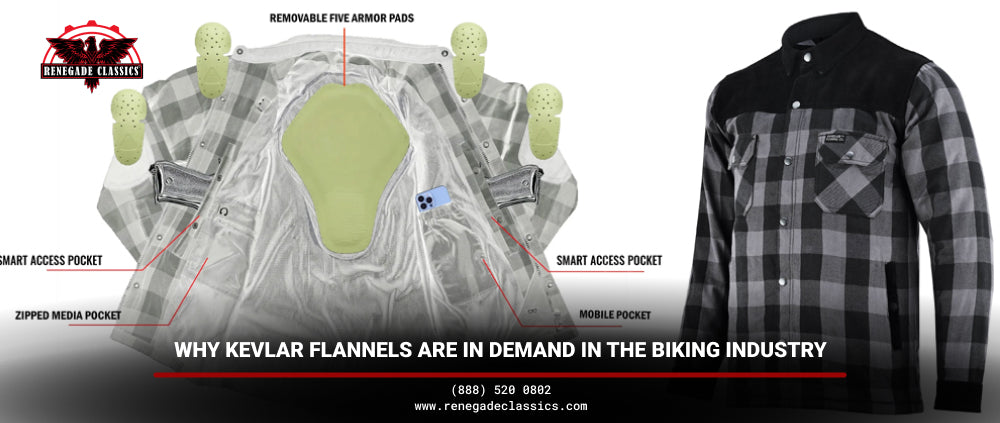
- CE armor integration: Dedicated armor pockets at the shoulders and elbows, sized for standard CE insert dimensions, with some options including a back pocket for optional spine protection. The CE level of included inserts varies by price point and product positioning.
- Construction quality variation: The breadth of the market means significant quality variation. Established riding brands with roots in the biker culture market produce riding-grade construction. Generic products using Kevlar terminology may not deliver equivalent quality in seam construction, armor pocket fit, or aramid fiber coverage.
What to Look for When Buying a Kevlar Flannel
Understanding what drives Kevlar flannel demand also clarifies what to verify before buying:
- Specific aramid fiber identification: The product description should name the specific aramid fiber used. "Kevlar lining" or "aramid lining" are appropriate descriptions. Vague references to "reinforced lining" without specifying the material type are insufficient.
- CE armor level: Verify that CE Level 1 or Level 2 certified inserts are included, not just armor pockets. Check the insert labels before riding. Pockets without certified inserts do not provide CE-rated impact protection.
- Coverage zone description: Understand whether the aramid lining covers only the shoulder and elbow zones or the full garment interior. This affects the abrasion protection profile of the shirt.
- Brand riding credibility: Brands with a track record in the riding shirt market and biker culture retail presence are more likely to produce genuinely riding-grade construction. Generic products using protective gear terminology without brand accountability carry more uncertainty about actual construction quality.
For the complete buying guidance, see the armored flannel buying guide.
For the full safety picture of what a motorcycle flannel provides, see the motorcycle flannel safety guide.
What to Read Next
- Armored flannel buying guide covers the full armored flannel category with verification guidance, construction quality indicators, and which options suit different riding contexts and budgets.
- Motorcycle shirt crash safety guide covers what Kevlar-lined armored shirts actually protect against in a crash and what their limits are.
- Motorcycle flannel safety guide covers the complete safety picture of motorcycle flannel shirts including what armored options provide and where their protection ends.
The Bottom Line
Kevlar flannels are in demand in the biking industry because they address a genuine gap between casual biker clothing with no protection and technical riding gear with no cultural fit in the Harley and cruiser riding community. They provide meaningful abrasion resistance from aramid lining and CE-certified impact protection from armor inserts in a garment that looks and wears like a biker flannel.
The demand will continue as long as riders want protection that fits their riding identity. The responsibility for the buyer is to verify that the specific product delivers what the category promises: genuine aramid fiber, genuinely CE-certified armor, and construction quality appropriate for riding use.
Browse armored flannel shirts at Renegade Classics for Kevlar and aramid-lined riding flannels from established biker culture brands.
Frequently Asked Questions
What is a Kevlar flannel for motorcycle riding?
A Kevlar flannel for motorcycle riding is a flannel shirt that incorporates aramid fiber lining at the key abrasion zones and CE-certified armor pockets at the shoulders and elbows. Kevlar is DuPont's brand name for para-aramid fiber, but the term "Kevlar flannel" is widely used to describe any aramid-lined riding flannel. The aramid lining provides abrasion resistance significantly better than standard cotton fabric. The CE armor provides certified impact protection at the joint zones.
Is Kevlar the only material used for abrasion resistance in flannels?
No. Kevlar is the most recognized brand name in the category but other aramid fibers, including Twaron and unbranded para-aramid fiber, serve the same abrasion resistance function. When evaluating a Kevlar flannel, the specific aramid fiber used should be named in the product description. What matters is that the lining is genuinely aramid fiber with the associated abrasion resistance properties, not that it specifically carries the Kevlar brand name.
Why are Kevlar flannels more popular than traditional leather jackets for some riders?
For riders who prioritize comfort in warm weather, plain clothes aesthetics for off-bike contexts, and a garment that fits their biker cultural identity rather than signaling technical riding gear, Kevlar flannels address specific needs that a traditional leather jacket does not. The demand is not a statement that Kevlar flannels are more protective than leather jackets. A leather jacket generally provides more comprehensive protection. The demand reflects that a garment worn consistently in more contexts provides more real-world protection across the riding year than a leather jacket worn only when comfortable.
Do Kevlar flannels actually protect you in a crash?
A properly constructed Kevlar flannel with genuine aramid lining and CE-certified armor inserts provides meaningful protection in a crash. The aramid lining reduces abrasion injury at the lined zones compared to standard fabric or bare skin. The CE armor absorbs and distributes impact force at the shoulder and elbow joints. The protection is genuine but not unlimited. It is appropriate for urban, casual, and event riding at legal road speeds. It is not the maximum protection available and is not a substitute for a full motorcycle jacket in high-speed riding scenarios.
What should I look for in a quality Kevlar flannel?
Look for four things. First, specific identification of the aramid fiber used (Kevlar, Twaron, or aramid fiber) in the product description. Second, CE Level 1 or Level 2 certified armor inserts included with the shirt, verified on the insert labels rather than only in the product description. Third, a description of the coverage zones: whether the aramid lining covers only the shoulder and elbow zones or the full garment interior. Fourth, a brand with genuine riding credibility and presence in the biker culture market. These four indicators separate a genuinely protective riding flannel from a fashion garment using protective gear terminology.


