

IMPORTANT: This article covers practical and general considerations for riders who legally carry firearms. It is not legal advice. CCW laws vary significantly by state and locality. Always verify current laws in every jurisdiction you ride through and consult a licensed attorney for guidance specific to your situation.
Key Takeaways
- Concealed carry on a motorcycle is legal in many states for riders with a valid CCW permit, but the specifics vary significantly by state. Verify the laws in your state and every state you ride through before carrying.
- Motorcycle riding creates specific challenges that standard CCW setups do not account for: riding position changes how holsters sit and access angles, wind at speed can expose a waistband carry, and vibration and movement add retention demands that a walking carry setup does not face.
- Carry position matters more on a motorcycle than in most other contexts. Cruiser riders in an upright position have more IWB options than sportbike riders leaning forward over the tank. Shoulder holsters and belly bands address the wind-exposure problem that waistband carry creates at highway speed.
- Retention is a higher priority on a motorcycle than in typical everyday carry. Vibration, wind, and the dynamics of riding require a holster with positive retention mechanisms. A passive friction holster that works for walking may not be adequate for highway riding.
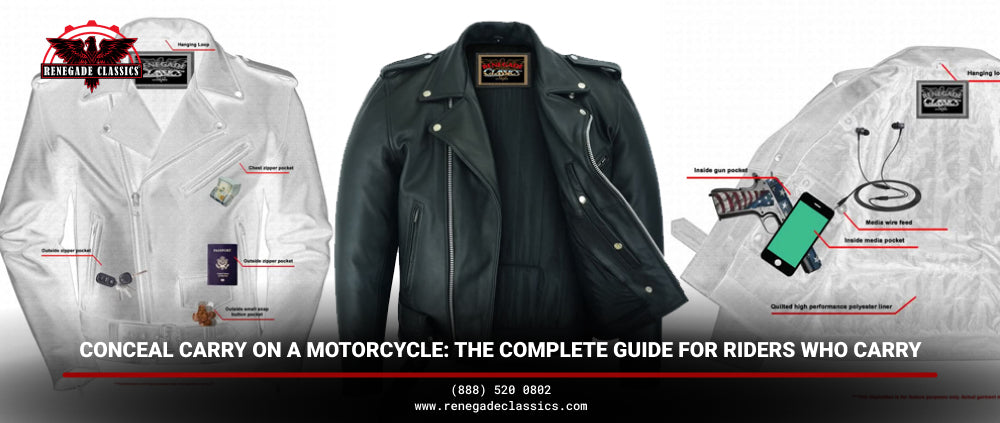
- The garment you wear is part of your CCW setup. A leather jacket, armored flannel, or vest serves as a cover garment in addition to its other functions. What you wear directly affects both concealment and draw access.
Concealed carry on a motorcycle presents challenges that standard CCW training and gear do not fully address. Riding position, wind exposure, vibration, and the mechanics of transitioning between riding and dismounted states all create specific requirements for the rider who carries. This guide covers those requirements and the practical decisions involved in building a setup that works on two wheels.
The Legal Foundation: Know Your State Laws
CCW laws vary significantly across states. What is legal in one state may not be legal in the next, and crossing state lines on a motorcycle creates a rapidly changing legal landscape. The following are general principles, not legal advice:
- A valid CCW permit from your home state is required to carry legally in most states. Many states have reciprocity agreements that honor other states' permits, but reciprocity is not universal and changes over time.
- Some states do not honor out-of-state CCW permits regardless of reciprocity. Riders crossing into those states must understand their obligations under that state's specific laws.
- Permit-less carry (constitutional carry) is in effect in a number of states, but the specific rules about who qualifies and what is permitted still vary.
- Even with a valid permit, specific locations such as government buildings, schools, certain private properties, and other restricted zones have their own rules that apply regardless of your permit status.
Before any multi-state ride, verify the current CCW laws for every state on your route. The USCCA and NRA both maintain reciprocity maps that can serve as a starting research point, but these should be verified against official state sources and are not substitutes for legal counsel. For the specific legal considerations of multi-state motorcycle rides with a firearm, see the multi-state motorcycle firearm guide.
Why Motorcycle Carry Is Different From Standard CCW
A CCW setup designed for everyday walking carry will encounter specific problems on a motorcycle:
- Wind exposure: At highway speed, clothing moves significantly. A shirt or garment covering a waistband carry can ride up or blow aside, exposing the firearm. This is a concealment and retention problem that does not exist when walking.
- Changed body geometry: The seated riding position compresses the waistband area and changes the angle of a hip carry. A holster that sits comfortably at 3 or 4 o'clock while standing may dig into the rider's hip or side when seated on a bike for hours.
- Vibration and movement: Road vibration, lean angles, and sudden stops apply forces to the holster and firearm that a walking carry does not encounter. A holster with passive friction retention may not be adequate under these conditions.
- Draw access: Drawing from a seated position on a motorcycle is a different motion than drawing while standing. The riding gear layering, body position, and throttle hand commitment all affect how and when a draw is possible.
- Gear layering: Riding gear, jackets, armored vests, and weather layers add access barriers between the hand and the firearm that are not present in a typical walking carry setup.
Carry Position by Riding Style
Cruiser and Touring Riders (Upright Position)
Cruiser and touring riders in an upright or slightly reclined seating position have the most carry options of any motorcycle riding style. The upright position keeps the waistband relatively uncompressed and maintains access angles closer to a standing carry.
- IWB at 3-5 o'clock: viable for cruiser riders with a proper belt and cover garment. Wind exposure at speed remains a concern.
- Shoulder holster under a jacket or vest: effective for concealment and access while seated, avoids the wind-exposure problem of waistband carry. Less comfortable in summer heat.
- Belly band: versatile positioning, sits higher on the torso to reduce wind exposure, works under a vest or jacket.
Sportbike Riders (Forward-Leaning Position)
Sportbike riders leaning forward over the tank face different constraints. The forward lean compresses the front of the waistband significantly and creates an access problem for standard IWB positions.
- Shoulder holster: preferred for sportbike riders because the firearm sits above the waistline where the forward lean does not affect access.
- Appendix carry with careful testing: some appendix carry setups remain accessible in a forward-lean position, but this must be tested specifically in the rider's seated position on their bike before relying on it.
- Compression undershirt with holster pocket: keeps the firearm high on the torso, addresses the forward-lean access problem.
Adventure and Off-Road Riders (Dynamic Movement)
Adventure riders face the most demanding retention requirements due to rough terrain, sudden weight shifts, and dynamic body movement. A holster adequate for highway cruising may not be adequate for off-road conditions.
- High-retention holsters with thumb break or active locking: preferred for the increased dynamic demands of off-road or mixed-terrain riding.
- Avoid ankle holsters on any motorcycle: consistently identified across multiple sources as unsuitable for motorcycle riding due to inaccessibility while seated and exposure risk.
Holster Selection for Motorcycle Carry
The holster is the most critical hardware decision for motorcycle CCW. Key selection criteria specific to riding:
- Positive retention: A thumb break, active locking mechanism, or purpose-built retention system is important for motorcycle carry. Passive friction holsters that rely on a snug fit alone may not be adequate under the vibration and dynamic forces of riding.
- Trigger guard coverage: Full trigger guard coverage is a non-negotiable requirement in any holster. This does not change for motorcycle carry.
- Tested in riding position: A holster should be tested while seated on the specific motorcycle before relying on it. Comfort and access in a showroom or while walking does not predict comfort and access while riding.
- Weather resistance: Kydex and polymer holsters handle rain, sweat, and temperature variation better than leather in demanding riding conditions. Leather holsters require more maintenance and may soften in wet conditions.
- No ankle holsters for motorcycle riding: Ankle holsters are inaccessible while seated on a motorcycle and are exposed to road debris, weather, and contact risk. Multiple sources consistently identify ankle carry as unsuitable for motorcycle riders.
Garments as Part of the CCW Setup
The garment worn over the holster is part of the overall CCW system on a motorcycle, not an afterthought. Several garment types serve double function:
- Leather jacket: Provides effective cover for shoulder holster or IWB carry, adds wind protection, and serves as riding protection simultaneously. The heaviest and most reliable cover garment in most weather conditions.
- Leather vest: An open-front leather vest does not fully cover a waistband carry at speed when wind is a factor, but works as a cover garment for shoulder holsters and provides an appropriate layer over belly band carry. Some CCW-specific vests include dedicated holster pockets.
- Armored flannel: Provides cover for IWB carry in cruiser seating positions and offers some weather protection. Wind performance at highway speed depends on fit and weight.
For the specific comparison between flannel and vest setups for motorcycle CCW, see the CCW flannel vs vest guide.
Safety Considerations Specific to Motorcyclists
- Do not draw while in motion: Drawing a firearm while operating a motorcycle at speed is extremely dangerous and should not be attempted. Draw access should only be considered when stationary in a safe position.
- Crash considerations: A hard holster positioned at a point likely to impact the ground in a slide or tumble creates additional injury risk. Consider holster placement in the context of crash scenarios, not only in the context of typical carry comfort.
- Practice the seated draw: Most CCW training focuses on drawing from a standing position. The seated draw on a motorcycle is a different motion and should be practiced specifically, safely, and without a loaded firearm during training.
- Off-body carry security: Tank bags, saddlebags, and backpacks are off-body carry options, but these require discipline: the bag must stay on the rider, not on the bike. An unsecured bag on the bike when the rider steps away creates an unsecured firearm situation.
What to Read Next
- CCW flannel vs vest guide covers the specific comparison between flannel and CCW vest setups for motorcycle carry.
- Multi-state motorcycle firearm guide covers the legal considerations specific to carrying a firearm across state lines on a motorcycle.
- Plain clothes rider guide covers how motorcycle flannels and apparel function as practical riding gear beyond their identity function.
The Bottom Line
Concealed carry on a motorcycle requires a setup designed specifically for riding conditions, not a walking carry setup transplanted to a bike. Riding position, wind, vibration, and gear layering all create specific demands that the holster, carry position, and cover garment need to address together.
Start with the legal requirements for your state and every state you plan to ride through. Then build a setup that addresses the practical challenges of motorcycle carry: positive retention, appropriate carry position for your riding style, and garments that serve as effective cover without creating access problems.
Browse motorcycle shirts and flannels at Renegade Classics for riding apparel that functions as part of a complete riding setup including concealed carry.
Frequently Asked Questions
Is it legal to conceal carry on a motorcycle?
In many states, yes, for riders with a valid CCW permit. However, CCW laws vary significantly by state, and riding across state lines means navigating the laws of every state on your route. Some states have reciprocity agreements that honor other states' permits; others do not. Verify current laws for every state you will ride through with official state sources and consult a licensed attorney for guidance specific to your situation. This article does not constitute legal advice.
What is the best holster for motorcycle concealed carry?
There is no single best holster for all riders. The right holster depends on your riding position, your motorcycle type, your cover garment, and your specific firearm. Cruiser riders in an upright position have more IWB options. Riders who lean forward benefit from shoulder holsters or belly bands that keep the firearm higher on the torso. Any holster chosen for motorcycle carry should have positive retention mechanisms beyond passive friction, full trigger guard coverage, and should be tested in your specific seated riding position before relying on it.
How do I prevent printing while riding?
Higher torso carry positions, such as shoulder holsters or belly bands, reduce the wind-exposure printing problem that waistband carry creates at highway speed. A leather jacket or heavier vest provides more consistent cover than a shirt or light flannel at speed. Testing your setup at highway speed in a safe environment before relying on it is an important step in any motorcycle CCW setup.
Can I draw my firearm while riding a motorcycle?
Attempting to draw a firearm while operating a motorcycle at speed is extremely dangerous and should not be attempted. Any draw should only occur when the motorcycle is stationary and you are in a safe position. A motorcycle CCW setup should focus on accessibility when dismounted or stationary, not while in motion.
Are ankle holsters suitable for motorcycle carry?
No. Ankle holsters are consistently identified across multiple CCW and motorcycle-specific sources as unsuitable for motorcycle riding. They are inaccessible while seated on a motorcycle, expose the firearm and holster to road debris and weather, and create access problems in virtually every motorcycle riding scenario. Other carry positions should be considered for motorcycle-specific use.


