

IMPORTANT: This article covers practical gear considerations for riders who legally carry firearms. It is not legal advice. CCW laws vary by state and jurisdiction. Always verify current laws for every state you ride through and consult a licensed attorney for guidance specific to your situation.
Key Takeaways
- A flannel shirt and a purpose-built CCW motorcycle vest serve different functions in a motorcycle carry setup. Understanding what each does well, and where each falls short, determines which one belongs in a given rider's setup.
- A standard motorcycle flannel can serve as a cover garment for IWB or shoulder carry, but it was not designed for CCW and has real limitations: wind performance at speed, lack of dedicated holster pockets, and fabric weight all affect how well it conceals and how quickly it allows access.
- A purpose-built CCW motorcycle vest has dedicated interior pockets at chest level designed specifically for firearm access from a seated riding position. These pockets are purpose-sized, positioned for draw access, and secured with closures that hold the firearm in place during riding.
- The flannel setup works better as a secondary cover garment or for lower-speed and off-bike casual carry. The CCW vest is the more purpose-designed solution for on-bike carry, particularly at highway speed where wind management matters most.
- Neither setup eliminates the need for a quality holster with appropriate retention. The garment covers and provides access. The holster secures the firearm.
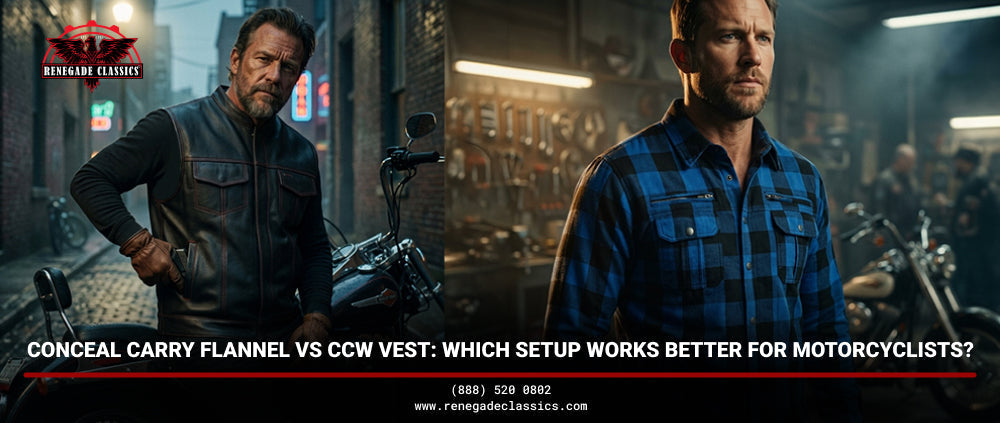
Conceal carry flannel vs CCW vest is a practical question for riders building a motorcycle carry setup. Both appear in discussions of motorcycle CCW. They serve different roles, have different strengths, and work better in different contexts. This guide compares them directly so riders can make an informed decision about which belongs in their setup.
What a Flannel Brings to a Motorcycle CCW Setup
What It Does Well
A motorcycle flannel, worn open over a tee or closed as the primary shirt, can serve as a cover garment for IWB or shoulder carry in certain conditions:
- At lower speeds and off the bike, an open flannel provides effective concealment for a waistband or shoulder holster. The fabric provides visual cover and stays reasonably in place when walking, standing, or riding at casual speeds.
- A heavier flannel with some structure reduces printing better than a lighter shirt because the fabric weight holds its position across the holster rather than draping closely to it.
- A flannel doubles as riding apparel for its primary functions: warmth, coverage, and biker identity. The CCW function is secondary but real in the right conditions.
- For riders in cruiser positions at moderate speeds, a well-fitted flannel can maintain concealment long enough for practical everyday carry purposes.
Where It Falls Short
A standard motorcycle flannel was not designed for CCW and has specific limitations in that role:
- Wind exposure at highway speed: At 60-70 mph, a flannel worn open will move significantly. The open front panel can be caught by wind and pulled away from the body, exposing a waistband carry. This is the most significant limitation of a flannel as a motorcycle CCW cover garment at highway speed.
- No dedicated firearm pocket: A standard flannel has no interior pocket sized and positioned for firearm access. The rider must draw from the holster through the open flannel front, which requires clearing a moving garment at speed or after dismounting.
- Inconsistent cover when buttoned: A buttoned flannel eliminates the wind-exposure problem but creates an access problem: drawing requires opening the buttons or using appendix carry that clears below the hem, neither of which is as fast as a purpose-built vest pocket.
- Fabric wear at holster contact points: Regular contact between the flannel fabric and a holster or firearm accelerates wear at friction points over time.
What a Purpose-Built CCW Motorcycle Vest Brings
What It Does Well
A purpose-built CCW motorcycle vest is designed specifically to solve the problems a standard flannel leaves unaddressed:
- Dedicated interior holster pockets: A true CCW motorcycle vest has one or more interior pockets positioned at mid-chest level on the front panels, sized to hold a holstered handgun. The pocket is accessible by reaching inside the open front of the vest. Left-side pocket for right-handed draw; right-side for left-handed draw.
- Pocket closure and retention: CCW vest pockets typically have a snap, zipper, or hook-and-loop closure that secures the firearm during riding vibration and movement, but can be opened quickly with one hand for access.
- Wind management: A well-fitted leather or canvas vest does not have the open-front wind-sail problem of a flannel at speed. The vest conforms to the body more closely and the front panels are weighted by the garment's structure.
- Consistent draw position: Because the firearm sits in a dedicated pocket rather than in a holster under a moving garment, the draw position is consistent and predictable regardless of wind or riding conditions.
- No holster-to-garment friction: The firearm is inside the vest pocket rather than in a holster against the skin. This eliminates the garment wear problem at holster contact points.
What to Look for in a CCW Motorcycle Vest
Not every vest with an interior pocket qualifies as a true CCW vest. Key criteria:
- Interior pockets positioned at mid-chest level, not near the hem. Low-positioned pockets are not accessible when seated on a motorcycle.
- Pocket sized for the specific firearm being carried, with enough depth and width that the firearm does not print through the vest exterior.
- Secure closure on the pocket that holds the firearm during riding but releases quickly with one hand.
- Vest fit that does not ride up when the rider reaches forward to the handlebars. A vest that shifts position during riding will shift the draw access point with it.
- Leather holds pocket shape better under the weight of a firearm than canvas, but canvas offers better ventilation in hot weather. Pocket placement and closure design matter more than material.
Where the CCW Vest Falls Short
- A CCW vest worn alone does not provide the warmth, coverage, or wind protection of a layered setup with a flannel underneath. It is an identity and carry garment, not a warmth layer.
- In summer heat, a leather CCW vest adds warmth that may not be practical in all riding conditions. Canvas or lighter vest options address this at some cost to pocket structure.
- A vest pocket still requires practiced access under pressure. The pocket must be opened, the firearm located, and the draw completed. This is a faster and more consistent process than clearing a flannel at speed, but it still requires specific practice.
When Each Setup Makes More Sense
The choice between a flannel cover garment and a CCW vest is not always either/or. Many riders use both in different combinations:
- CCW vest as the primary carry solution: Best for on-bike carry at highway speed, for riders who prioritize consistent draw access, and for any riding context where wind management of a cover garment is a priority.
- Flannel as secondary cover over IWB or shoulder carry: Works for lower-speed riding, off-bike carry, and casual everyday contexts where wind is not a significant factor. An open flannel over a shoulder holster at casual speeds provides effective concealment.
- CCW vest plus flannel underneath: The layered combination that many riders use in cooler weather. The flannel provides warmth. The vest provides the CCW function. The firearm is in the vest pocket, not in a holster against the body under multiple layers.
For the full guide to motorcycle CCW holster options and riding-position carry considerations, see the conceal carry motorcycle guide.
The Holster Still Matters
Whether the cover garment is a flannel or a CCW vest, the holster or pocket holster used inside it remains a critical component. A CCW vest pocket with no holster means the trigger is unprotected, which is a safety problem. Most CCW vest pockets are designed to work with a universal or pocket holster that provides trigger guard coverage while keeping the firearm accessible.
Key principle: the garment conceals and provides access. The holster secures the firearm and protects the trigger. Both are required.
What to Read Next
- Conceal carry motorcycle guide covers the full range of holster options, carry positions by riding style, and the practical challenges of on-bike CCW.
- Multi-state motorcycle firearm guide covers the legal considerations for riders carrying across state lines.
- Plain clothes rider guide covers how motorcycle flannels function as practical riding gear in multiple capacities beyond their identity function.
The Bottom Line
A purpose-built CCW motorcycle vest is the more purpose-designed solution for on-bike concealed carry, particularly at highway speed. It provides a dedicated, accessible firearm pocket, consistent draw position, and better wind management than a flannel used as a cover garment.
A motorcycle flannel works as a secondary cover garment in lower-speed and off-bike contexts, and pairs effectively with a CCW vest as a warmth layer underneath in cooler weather.
Neither eliminates the need for a quality pocket holster with trigger guard coverage inside the carry pocket.
Browse leather vests at Renegade Classics for motorcycle vests suited to both riding and CCW setups.
Frequently Asked Questions
Can a regular flannel shirt work as a concealed carry cover garment on a motorcycle?
Yes, with significant limitations. An open flannel provides concealment for IWB or shoulder carry at lower speeds and off the bike. At highway speed, the open front panel can be exposed by wind, creating a printing or exposure problem. A flannel also has no dedicated firearm pocket, so the draw requires clearing a potentially moving garment rather than accessing a dedicated interior pocket. For highway riding, a purpose-built CCW vest addresses these limitations more effectively.
What makes a motorcycle vest a CCW vest?
A purpose-built CCW motorcycle vest has interior pockets specifically positioned at mid-chest level, sized to hold a holstered handgun, and secured with a closure that can be opened with one hand. These pockets are accessible by reaching inside the open front panel of the vest. Standard riding vests may have interior pockets, but these are typically positioned too low, too small, or without the closure design needed for reliable firearm access from a seated riding position.
Do I still need a holster if I use a CCW vest?
Yes. A CCW vest pocket conceals and provides access to the firearm, but a pocket holster inside the pocket is still required for trigger guard protection. Carrying a firearm in a vest pocket without a holster leaves the trigger exposed, which is a safety problem regardless of the garment. Most CCW vest pockets are designed to accept a universal or pocket holster that provides trigger coverage while keeping the firearm accessible.
Can I layer a flannel under a CCW vest?
Yes, and this is a common combination for cooler weather riding. The flannel provides warmth and coverage. The CCW vest goes over it and provides the carry function. The firearm sits in the vest interior pocket rather than in a holster against the body under multiple layers, which maintains access without requiring the rider to clear through both garments for a draw.
Which is better for summer riding, a CCW vest or a flannel?
In summer heat, a leather CCW vest adds warmth that can be uncomfortable on long rides. A lighter canvas or denim CCW vest addresses this with better ventilation. A flannel as a cover garment is typically too warm in summer conditions and performs poorly as a wind-resistant cover garment at speed regardless of season. In true summer heat, a belly band or compression undershirt with a holster pocket, under minimal outer clothing, is an option several sources identify for hot-weather motorcycle carry.


