

Key Takeaways
- The visual language of American biker style developed primarily in the decade following World War II, when veterans returning from the war formed motorcycle clubs and built a riding culture with its own clothing codes, symbols, and community markers.
- Biker apparel began as functional workwear adapted for riding conditions: leather for wind and road protection, denim for durability, boots for ankle support and grip. The identity function came later, as the culture developed and the clothing became inseparable from membership in it.
- The graphic tee entered biker culture later than leather and denim, gaining prominence in the 1970s and 1980s as screen printing became more accessible and Harley-Davidson began producing branded apparel with the eagle, flag, and skull imagery that remains central to the category today.
- Flannel in biker culture draws from the working-class American tradition it already occupied before riders adopted it: durable, warm, and aligned with the rugged practical aesthetic that biker culture has always claimed as its own.
- The biker visual code has remained remarkably stable since the 1950s and 1960s when it was established. Later developments, including the graphic tee explosion of the 1970s-80s, the women's biker apparel expansion, and the minimalist trend of recent decades, are additions to the core vocabulary rather than replacements of it.
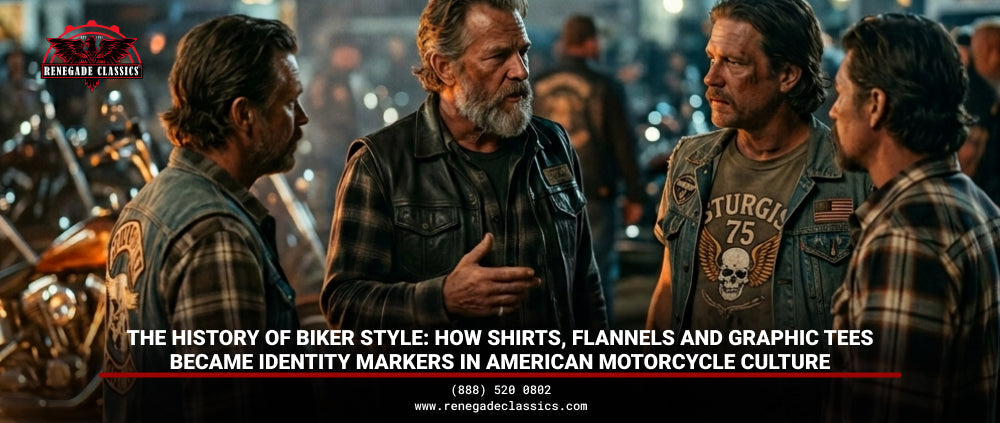
The history of biker style is the history of functional clothing becoming cultural identity markers. The graphic tee, the flannel shirt, the leather vest, and the boots that define American motorcycle culture today did not begin as identity statements. They began as the most practical options available for people riding motorcycles on American roads in the mid-twentieth century. Understanding how they became the symbols they are today requires looking at the specific history that transformed them.
The Post-War Foundation: 1945-1955
The defining period for American biker style is not the era of the first motorcycles but the decade immediately following World War II. Veterans returning from the war brought with them several things that would shape the culture: experience with motorcycles as military vehicles, a taste for organized group activity, surplus military clothing and leather, and a restlessness that peacetime civilian life did not easily absorb.
Motorcycle clubs formed across the country through the late 1940s. The clothing these early clubs wore reflected what was available, practical, and aligned with the military culture they were coming from:
- Leather jackets, already in use by military aviators and adapted for motorcycles since the 1928 introduction of the Schott Perfecto, became the standard outer layer. The same horsehide leather that had protected pilots from cockpit wind offered protection from the road.
- Denim jeans and work pants were the dominant casual bottom of American working-class culture. Durable, cheap, and available, they required no adjustment for motorcycle riding.
- Work boots and military boots provided the ankle protection and grip that motorcycle riding required.
- Plain white or colored cotton t-shirts, then largely an undergarment or workwear piece, were the practical inner layer under leather in warmer riding conditions.
These were not aesthetic choices. They were the most practical options for the activity. The identity function developed as the culture around the activity developed.
Hollywood, Hollister, and the Birth of the Biker Image: 1947-1960
Two events in the late 1940s and 1950s dramatically accelerated the development of a specifically biker visual identity.
The 1947 Hollister incident in California, which drew national media attention with sensationalized accounts of motorcycle club disorder at a racing event, established bikers in the American public imagination as an outlaw counterculture. Whether the reporting was accurate is a separate question. The effect was real: biker identity became associated with rebellion, outsider status, and deliberate separation from mainstream society.
Then came Marlon Brando in The Wild One in 1953. Brando's character wore a Schott Perfecto leather jacket, jeans, and boots. The film established the visual archetype of the American biker for mass culture. It also established leather, denim, and the confrontational aesthetic of the club rider as the definitive look of the counterculture outsider.
After The Wild One, the clothing choices that riders were already making for practical reasons took on a second layer of meaning. The leather jacket was not just protection. It was a statement of identity, rebellion, and belonging to the riding community rather than to mainstream American life.
Club Culture and the Vest: 1950s-1960s
As motorcycle clubs formalized through the 1950s and into the 1960s, a new garment entered the core biker vocabulary: the leather vest worn over the leather jacket or, in warmer climates, over a shirt as the primary outer layer.
The vest solved a specific problem that the leather jacket did not: in the American South and West, where temperatures frequently made a full leather jacket impractical for riding, a sleeveless leather vest provided wind protection without the heat of full sleeves. Southern California clubs, where temperatures regularly exceeded 100 degrees Fahrenheit, are credited with establishing the vest as a standard riding garment.
More significantly, the vest became the primary surface for patch display. Club colors, chapter identifiers, event attendance patches, and personal graphics could be sewn onto the back and front of the vest in a way that a leather jacket did not as naturally accommodate. By the mid-1960s, the patched leather vest was fully established as the community identity document of motorcycle club culture.
For more on why flannel became part of this tradition, see the why bikers wear flannel guide.
Easy Rider and the 1960s-1970s Expansion
If The Wild One established the visual archetype of the biker in the 1950s, Easy Rider (1969) expanded and complicated that image for the 1960s counterculture. The film brought the motorcycle into the broader cultural conversation about freedom, America, and individuality, reaching an audience well beyond the existing riding community.
Through the 1960s and into the 1970s, motorcycle culture grew significantly in American life. This growth had specific effects on biker apparel:
- The culture expanded beyond the original club-centric model to include a wider range of independent riders who identified with biker aesthetics without being formal club members.
- Denim jackets and vests, already established in general American workwear culture, entered biker culture as alternatives to leather for riders who wanted the patch-display function of the vest without the heat or cost of leather.
- The flannel shirt, already deeply embedded in American working-class dress, became increasingly common in biker culture as the culture's demographic widened beyond the original post-war club formation period.
The Graphic Tee Era: 1970s-1980s
The graphic t-shirt entered biker culture significantly later than leather and denim. Its rise corresponds with two developments: the expansion of screen printing technology that made graphic tees commercially accessible, and Harley-Davidson's deliberate move into branded apparel.
During the 1970s and 1980s, Harley-Davidson began producing branded t-shirts featuring the eagle, American flag, skull, and logo imagery that would define the biker graphic tee category. These shirts were sold at dealerships and at the growing network of motorcycle rallies, putting brand-graphic apparel directly into the hands of the riding community.
The rally context proved critical for the graphic tee's adoption. Sturgis and Daytona Bike Week grew through this period, and event-specific graphic tees, produced in large quantities and sold on-site, became an expected part of the rally experience. Buying and wearing the year-specific event tee became a cultural ritual that continues to the present.
By the late 1980s, the graphic tee had become a standard part of the biker visual vocabulary alongside leather and denim. Skull designs, patriotic graphics, and brand imagery had established themselves as the core visual language of the biker graphic tee category, a language that remains largely stable today.
The Code Stabilizes: 1990s-Present
From the 1990s onward, the core elements of the biker visual code have remained largely stable. The graphic tee, leather vest, dark denim, and boots that define the look today are the same elements that defined it in the 1960s and 1970s, with the graphic tee category added and expanded.
Several developments within this stable core are worth noting:
- Women's biker apparel: Women's participation in riding culture grew significantly through the 1990s and 2000s, and the women's biker apparel category expanded in parallel. Purpose-designed women's cuts in graphic tees, flannels, and vests became standard offerings across the category.
- Commercial expansion and licensing: Harley-Davidson's licensing program expanded the availability of branded biker apparel well beyond the dealership network. The iconic imagery of the brand became widely available and commercially mainstream while retaining its cultural association with riding identity.
- The minimalist trend: A quieter, more understated register of biker apparel has grown alongside the traditional bold graphic aesthetic. Clean logos, simple designs, and less ornamented vests reflect a broadening of the biker aesthetic without displacing the classic loud graphic approach.
For the comparison between vintage and modern design aesthetics within this history, see the vintage vs modern biker shirt graphics guide.
What to Read Next
- History of flannel guide covers the full history of flannel as a fabric and garment, from its origins through its adoption in American working-class and biker culture.
- History of t-shirts guide covers how the t-shirt evolved from undergarment to cultural canvas, including its adoption as the primary graphic vehicle in biker culture.
- Why bikers wear flannel guide covers the specific history of flannel in motorcycle culture and how it moved from workwear to riding identity.
The Bottom Line
The history of biker style is a history of practical clothing becoming cultural symbols. Leather, denim, and boots began as the most practical options for riding. They became identity markers as the community that wore them developed its own values, symbols, and codes. The graphic tee arrived later but was adopted rapidly because it provided a flexible, affordable surface for the visual language the culture had already developed in patches and emblems.
The core visual code has been remarkably stable since it was established in the 1950s and 1960s. What has changed are the additions to and variations within that code, not the fundamental vocabulary of what biker identity looks like in clothing.
Browse motorcycle shirts and flannels at Renegade Classics for biker apparel that connects to this tradition.
Frequently Asked Questions
When did the modern biker style develop?
The core of what we recognize as modern American biker style developed primarily in the decade following World War II, from the late 1940s through the mid-1950s. Post-war veterans forming motorcycle clubs established leather, denim, and boots as the standard biker kit. The 1953 film The Wild One codified this look for popular culture. The vest with patches was established by the mid-1960s. The graphic tee became central to the vocabulary in the 1970s and 1980s.
When did graphic tees become part of biker culture?
The graphic t-shirt became a significant part of biker culture in the 1970s and 1980s, when Harley-Davidson began producing branded graphic tees with eagle, flag, and skull imagery, and when motorcycle rallies like Sturgis and Daytona Bike Week developed the event-specific tee as a cultural ritual. The graphic tee entered the biker vocabulary later than leather and denim, which had been established since the late 1940s.
Why does the biker visual code look the same as it did decades ago?
The biker visual code has remained stable because it communicates values that have not changed: freedom, independence, community, and the riding life. The specific garments, leather, denim, boots, graphic tees, became identity markers because of what they communicated in the cultural moment of their adoption. Those communications have remained accurate for the culture across decades, which is why the code persists without requiring significant change.
How did Hollywood influence biker style?
Hollywood amplified and accelerated the development of biker visual identity in two key moments. The Wild One (1953) established the leather jacket, jeans, and boots look as the visual archetype of the American biker for mass culture. Easy Rider (1969) brought motorcycle culture into the broader counterculture conversation of the 1960s and expanded its reach beyond the original club-centric model. Film and television have continued to shape public perception of biker style across every subsequent decade.
What role did Harley-Davidson play in biker fashion history?
Harley-Davidson played several roles in biker fashion history. As the dominant American motorcycle manufacturer, their machines became the cultural anchor of Harley and cruiser riding identity. From the 1970s and 1980s onward, their branded apparel program introduced graphic tees with eagle, flag, and skull imagery that defined the biker graphic tee category commercially. Their licensing program made biker-aesthetic apparel widely available beyond the dealership network and helped establish the specific visual vocabulary that most people associate with American biker culture.


