

Key Takeaways
- The visual similarity among Harley riders at motorcycle rallies is not accidental or superficial. It reflects a cultural tradition in which shared visual identity is valued over individual distinction as a primary expression of belonging.
- The core rally uniform, graphic tee, leather vest, jeans, and boots, has been the consistent biker culture look since the 1950s and 1970s. Its persistence reflects cultural continuity rather than a failure of individual style.
- The rally environment reinforces conformity through social feedback: riders dress in the style that is recognized and respected within the community. Dressing outside that style at a biker rally is possible, but the social recognition that comes from fitting the visual code is a genuine draw.
- Vendor culture at major rallies narrows the available options further. The shirts, vests, and gear available from rally vendors are produced in the established biker aesthetic. Buying at the event means buying into the uniform.
- Significant individual expression exists within the uniform. Patch configurations, specific graphics, vest hardware, and accessory choices vary enormously even when the garment types are the same.
Why Harley riders dress the same at motorcycle rallies is a question that outsiders ask and insiders rarely think about. From outside the culture, the visual similarity is striking: walk through Sturgis or Daytona and the same elements appear everywhere. From inside the culture, the shared visual code is not conformity imposed from outside but identity chosen from within. Understanding why requires looking at what the uniform communicates and why it has persisted.
The Observation That Prompts the Question
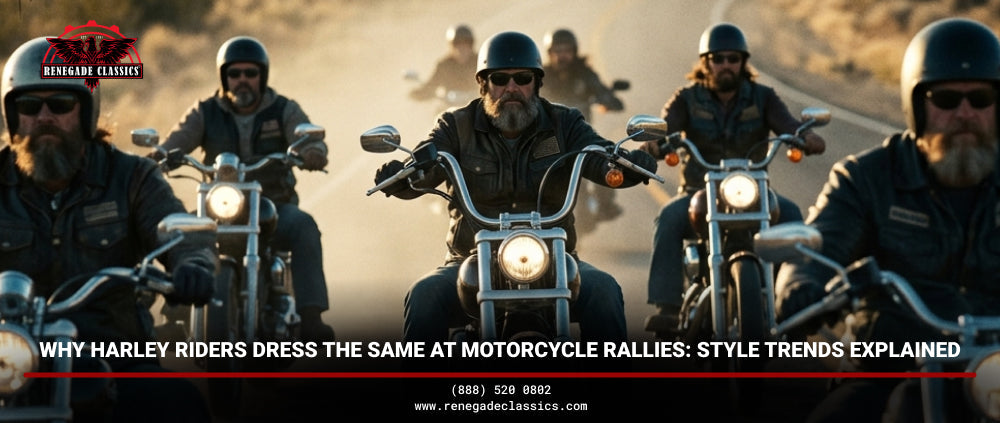
An outside observer at a major Harley rally notices quickly that the visual range is narrower than in most other large public gatherings. The same garment types appear on most riders: graphic tee or sleeveless shirt, leather vest with patches, dark jeans, leather boots. The specific graphics vary. The patch configurations differ. The boots are not identical. But the garment vocabulary is remarkably consistent.
This consistency is real. It is not an optical illusion created by the density of the crowd. Harley rally culture has a recognizable visual code that most attendees operate within, and that code has remained relatively stable over decades.
The Uniform Is Not Accidental
The biker rally visual code did not emerge from a central authority or a dress code enforced by anyone. It developed organically from the culture's history and has been self-reinforcing ever since. Its origins trace to the post-World War II motorcycle clubs that established the visual language of biker identity: leather, denim, boots, skull graphics, and patch-covered vests as the physical markers of club membership and riding commitment.
As biker culture grew and events like Sturgis became major national gatherings, the visual code spread beyond club membership into the broader riding community. Riders who were not club members adopted the same garment types because those garments communicated the identity they shared: the riding life, the community, the values.
By the time Harley-Davidson began incorporating elements of the visual code into its commercial branding in the 1980s and 1990s, the uniform was already deeply established. The commercial reinforcement amplified what the culture had already developed from within.
Why the Uniform Persists
Shared Identity Over Individual Distinction
The first and most important reason the uniform persists is that Harley and cruiser culture has historically valued shared identity over individual distinction as the primary mode of community expression. This is not unique to biker culture. Many communities with strong shared identity, military, sports, and religious communities among them, use consistent visual codes to express belonging and mutual recognition.
In biker culture, the visual code communicates membership in a community with shared values: freedom, the road, independence, and the riding life. A rider who dresses within the code is expressing alignment with those values in a way that other riders recognize immediately. That recognition is its own reward and a significant part of why the uniform persists even as individual riders could choose to dress differently.
The Rally Environment Reinforces Conformity
A motorcycle rally is a social environment where the primary audience for your appearance is other riders. The feedback loop operates differently than in everyday settings where the audience is mixed. At Sturgis or Daytona, the person looking at your vest and graphics is likely someone who knows exactly what each patch means, which graphics are classics and which are generic, and whether the boots are real riding boots or decorative ones.
This audience competence creates social pressure toward the established code. Fitting the visual vocabulary of biker culture at a biker rally generates the social recognition that most attendees are there to experience: the nod, the conversation opener, the patch comment, the shared knowledge. Dressing outside the code does not generate the same recognition.
Vendor Culture Narrows the Options
The shirt and gear vendors at major motorcycle rallies produce and sell within the established biker aesthetic. Rally tees come in skull graphics, patriotic designs, brand imagery, and event-specific graphics. Vests are leather. Accessories are metal and leather. The range of what is available to buy on-site is the range of what has historically sold in the biker culture market.
A rider who arrives at Sturgis with the intention of buying shirts at the event will buy from vendors whose product range is defined by that aesthetic. The buying environment reinforces the uniform by making alternatives less available in that context.
The Uniform Is Practical
The garment types that make up the biker rally uniform are also the garment types that work for motorcycle riding. Leather provides wind block and some road protection. Boots protect the ankle and provide grip. Dark denim resists dirt and minor road debris. The graphic tee is the most comfortable single layer in summer riding heat.
The uniform persists partly because it works. A rider who chooses the standard kit for practical riding reasons ends up in the standard kit for cultural reasons simultaneously. The two reinforce each other.
What Varies Within the Uniform
The visual similarity at a Harley rally is real at the level of garment type. At the level of individual expression within those garment types, the variation is significant:
- Patch configurations on the vest: No two patched vests are identical. The specific clubs, events, chapters, and personal graphics on a vest tell a rider's history in a way that is unique to that individual. This is where the most personal expression within the uniform lives.
- Graphics on the tee: While the graphic tee is a consistent garment type, the specific design communicates individual aesthetic choice within the biker graphic vocabulary. A vintage motorcycle silhouette tee and a skull tee are both within the code but communicate different things about the rider.
- Vest hardware and customization: Buckles, conchos, fringe, studs, and other vest hardware vary significantly between riders and are a site of individual customization within the shared garment type.
- Boot style: Engineer boots, harness boots, Western boots, and classic motorcycle boots are all within the code but carry different regional, historical, and personal signals.
The uniform provides a shared framework. Individual expression operates within that framework rather than against it.
For the full comparison between the dress styles of club riders and solo riders within this framework, see the club riders vs solo riders style guide.
Is the Uniform Changing?
The biker rally visual code has remained remarkably stable over decades, but it is not entirely static. A few observable trends within the culture:
- The minimalist biker aesthetic has grown in the broader riding culture. Cleaner, less ornamented vests and simpler graphic tees are more represented than they were in earlier rally eras.
- Women's biker apparel has diversified significantly. The women's presence at major rallies has grown and the apparel range available to women riders is more varied than it was in earlier decades.
- Adventure and sport touring riders who attend Harley-centric rallies sometimes arrive in their own riding gear, creating a visible contrast with the traditional Harley rally uniform.
These variations exist at the margins of the core uniform, which has not fundamentally changed. The graphic tee, leather vest, jeans, and boots remain the dominant visual code at Harley and cruiser rallies.
What to Read Next
- Sturgis, Daytona and Laconia guide covers what riders actually wear at the three largest American rallies and how the apparel approach differs by event.
- Club riders vs solo riders style guide covers how the visual code differs between organized club riders and independent solo riders within the same broad biker culture.
- Sturgis shirt count guide covers the practical apparel packing question for first-time Sturgis attendees.
The Bottom Line
Harley riders dress similarly at motorcycle rallies because the shared visual code of biker culture is how community membership and shared values are expressed in that context. The uniform is not imposed from outside. It developed organically from the culture's history, is reinforced by the social dynamics of the rally environment and the vendor culture that serves it, and persists because it works both practically and culturally.
The variation within the uniform, in patches, graphics, hardware, and personal history, is where individual identity lives. The framework is shared. The expression within it is not.
Browse motorcycle shirts and flannels at Renegade Classics for the graphic tees, flannels, and vests that are the foundation of the biker rally wardrobe.
Frequently Asked Questions
Why do bikers all dress the same at motorcycle rallies?
The visual similarity at Harley and cruiser rallies reflects a cultural tradition in which shared identity is expressed through a consistent visual code rather than through individual distinction. The code, graphic tee, leather vest, jeans, and boots, developed from the post-WWII motorcycle club culture that established biker identity, was reinforced commercially through Harley-Davidson branding from the 1980s onward, and persists because fitting the code generates social recognition within the community that dressing outside it does not.
Is there a dress code at Sturgis or Daytona?
There is no formal enforced dress code at Sturgis, Daytona Bike Week, or other major motorcycle rallies. The visual similarity comes from a shared cultural code that riders adopt voluntarily rather than from any rule. Riders can and do wear whatever they choose. The degree to which the established visual code generates community recognition at a biker rally is a social dynamic, not an enforcement mechanism.
Does individual expression exist within the biker rally uniform?
Yes, significantly. While the garment types at a Harley rally tend to be consistent, the specific expression within those types varies considerably. Patch configurations on vests are unique to each rider and tell individual riding histories. Graphics on tees reflect personal aesthetic choices within the biker vocabulary. Vest hardware, boot styles, and accessories vary between riders even when the overall garment framework is the same. The uniform provides a shared framework; individual expression operates within it.
Why does the biker rally uniform include a leather vest specifically?
The leather vest serves multiple functions in biker culture simultaneously: it provides wind block for riding, it carries patches that communicate club membership and riding history, it layers over any shirt in any weather condition, and it is the most culturally recognized outer garment in the Harley and cruiser riding tradition. Its persistence across decades reflects all of these functions operating together rather than any single factor driving its continued dominance.
Are newer riders expected to dress in the traditional biker style at rallies?
New riders are not required or explicitly expected to adopt the traditional biker visual code. However, the social dynamics of a biker rally are such that fitting the visual vocabulary generates recognition and connection that dressing outside it typically does not. Most new riders who attend major rallies naturally adopt elements of the code, in part because that is what the vendors sell and in part because it is the look they associated with the culture before they began riding. The code is self-reinforcing for these reasons without requiring any explicit pressure.


