

Key Takeaways
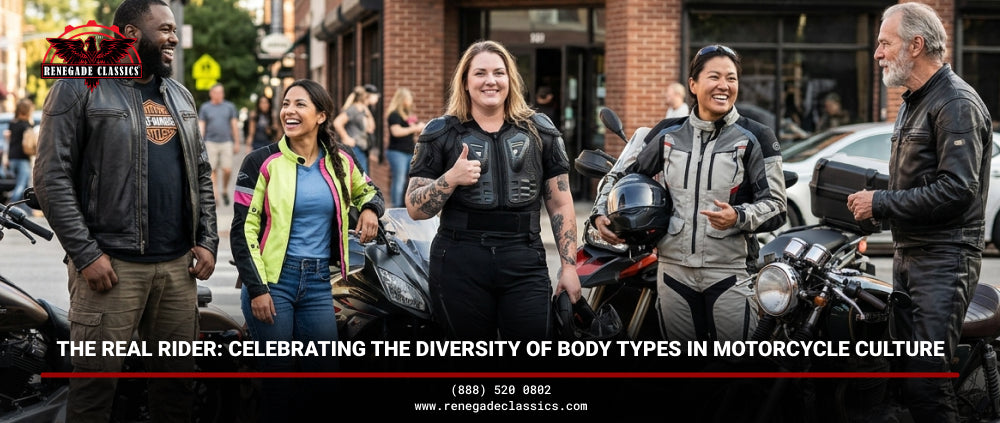
- Motorcycle culture has never been defined by a single body type, despite marketing imagery that has historically favored a narrow representation. The actual riding community has always included a far wider range of builds, backgrounds, and identities than that image suggested.
- Female ridership has grown significantly over the past two decades, reshaping both the cultural identity of the riding community and the gear market that serves it. Female riders are now well represented at every level of the riding community.
- The gear market has responded to body diversity with expanded sizing across categories: extended sizes for larger builds, purpose-built women's cuts for female riders, and slimmer fitted options for slender riders. The range of gear available for diverse body types is broader now than it has been in recent decades.
- The core of biker identity has always been about riding, not about what the rider looks like. The values that define biker culture, freedom, independence, community, and the road, do not belong to any particular body type.
Diversity of body types in motorcycle culture is not a new development that needs to be introduced. It is a reality that has always been true and is becoming more visible. The rider on the road next to you has always come in every size, shape, and build. What has changed is the gear market's recognition of that reality and the broader cultural conversation acknowledging it.
This article celebrates what has always been true about the riding community and what the gear market is doing to better serve the full range of riders who make it up.
The Myth of the Default Biker
The image of the default biker in American popular culture has long been a specific type: large, physically imposing, white, and male. This image has roots in the early outlaw club culture of the 1940s and 1950s and was reinforced by decades of film, television, and marketing that drew from that same narrow well.
The problem with the default biker image was never that it described some riders. It did. The problem was that it implied a requirement. That you needed to look a certain way to belong.
The reality on the road was always different. Women have been riding motorcycles since the earliest days of the machine. Riders of every size and build have always been part of the community. Clubs have always existed across racial, ethnic, and occupational lines. The community was always broader than the image suggested.
What is changing is not the composition of the riding community but the visibility of its actual breadth. The gap between the marketing image and the riding reality is closing.
How Biker Culture Has Always Been More Diverse Than Its Image
The history of American motorcycle culture includes more diversity than the dominant cultural narrative has typically acknowledged:
- Women riders: Women have been riding motorcycles competitively and recreationally since the early twentieth century. The Motor Maids, founded in 1940, is among the oldest American motorcycle organizations and has always been exclusively for women. Female riders did not arrive recently. They have always been here.
- Riders across the size spectrum: There is no physical size requirement for riding a motorcycle. The sport requires skill, balance, and judgment. Riders of every build have always participated. The gear market's historical failure to serve larger or smaller riders was a market gap, not a cultural one.
- Diverse communities: Motorcycle clubs have existed across racial, ethnic, occupational, and interest lines for as long as organized riding communities have existed. Veteran riding organizations, occupational clubs, and culturally specific riding groups have deep roots in American motorcycle culture alongside the more widely publicized outlaw and touring club traditions.
The diversity has always been there. The conversation about it is what is newer.
The Gear Market's Response to Body Diversity
The most concrete and measurable way that motorcycle culture's diversity is being acknowledged is in the gear market. Apparel and equipment manufacturers have expanded their offerings to serve body types that were historically underserved.
Extended Sizing
Extended sizing in motorcycle apparel now reaches further than it did a decade ago. Shirts, flannels, and riding gear in larger sizes are available from more brands and across more product categories. This expansion is driven by demand from riders who were previously unable to find gear that fit.
For big and tall riders specifically, the quality of extended size options has improved alongside the quantity. Early extended size motorcycle apparel was often standard sizing simply made larger, without accounting for the proportional differences that big and tall riders need. Better extended sizing now accounts for shoulder width relative to chest size, arm length proportions, and torso length.
For the complete big and tall gear guide, see the big and tall motorcycle gear guide.
Women's Cuts
Purpose-built women's motorcycle apparel has expanded dramatically. Female riders no longer need to choose between men's gear in smaller sizes or fashion clothing with no protective function. Women's cut riding shirts, flannels, armored options, and vests are available in genuine women's proportions with appropriate fit and, in armored options, armor placement designed for female riders.
This expansion directly reflects the growth of female ridership and the market demand that came with it. The gear market responded to riders who existed and were asking for gear that served them.
For the full guide to the growth of female ridership and the gear that serves it, see the women riders on the rise guide.
Slim and Fitted Options
The traditional biker shirt cut runs relaxed to accommodate a range of builds comfortably. Slim and fitted options have expanded for riders who find standard cuts too loose. These options serve slender riders who cannot find gear that fits correctly in standard sizing and riders across all builds who prefer a closer silhouette.
For guidance on finding motorcycle shirts that fit well for slender riders, see the thin guys motorcycle shirt guide.
What Real Diversity in Motorcycle Culture Looks Like
The riding community today includes:
- Riders across the full size spectrum from petite to plus size, all on the road with the same destination: the ride.
- Female riders who lead groups, found clubs, compete in events, and participate in every aspect of riding culture as riders.
- Riders from every occupational and ethnic background, organized in clubs that reflect the full range of American community life.
- New riders who came to the community from unexpected paths and experienced riders with decades of road behind them.
- Riders who match the traditional visual image of biker culture and riders who do not, all sharing the same values that define what being a rider actually means.
The unifying element is not appearance. It is the choice to ride. That choice does not require any particular build, background, or look. It requires a motorcycle and the desire to be on it.
Finding Gear That Fits Your Build
For riders of all body types, the practical reality is that finding gear that fits requires knowing what to look for and where to look. A few principles that apply across builds:
- Riding position fit matters more than standing fit: Every piece of riding apparel should be evaluated in a riding position, not a standing one. The back hem, sleeve length, and chest fit all change when leaning forward with arms extended. Check the fit that matters, not the one that is easiest to check.
- Size charts vary by brand: Do not assume your size in one brand translates to the same size in another. Measure and compare to the specific brand's size chart before buying.
- Purpose-built cuts serve proportions that standard cuts do not: Women's cuts, big and tall cuts, and slim fits are not marketing labels. They are proportional adjustments that make gear work correctly for the specific build they are designed for. The right cut makes a significant practical difference.
- Armor placement must be verified regardless of size: CE armor that is not positioned over the correct joint does not provide the protection it is certified to deliver. Verify shoulder and elbow armor placement in riding position after any armored gear purchase, regardless of what size label the garment carries.
Browse motorcycle apparel at Renegade Classics for riding shirts, flannels, and apparel in a range of sizes and cuts for riders of all builds.
What to Read Next
- Women riders on the rise guide covers the growth of female motorcycle ridership and how it has changed both the culture and the gear market.
- Big and tall motorcycle gear guide covers practical gear selection and sizing guidance for riders who need extended sizing.
- Thin guys motorcycle shirt guide covers fit challenges and solutions for slim and slender riders looking for motorcycle shirts that actually fit.
The Bottom Line
The real rider has always come in every body type. The road does not care about size. The motorcycle does not care about build. The riding community, at its core, has always cared about the ride.
What is better now than it was before is the gear. The market is catching up to the reality that riders have always known: the person on the motorcycle can look like anyone. The gear should fit that person, not a narrower ideal of what a rider is supposed to look like.
Browse motorcycle shirts and flannels at Renegade Classics for riding apparel in sizes and cuts for the full range of riders who make up the motorcycle community.
Frequently Asked Questions
Do you need a specific body type to ride a motorcycle?
No. Motorcycle riding requires skill, balance, and judgment, not a particular physical build. Riders of every size, shape, and body type ride motorcycles and participate fully in riding culture. The historical image of the biker as a specific physical type was always a narrower representation than the actual riding community. The road is open to any rider with the skills and desire to be on it.
Has motorcycle culture always been diverse?
Yes, in meaningful ways that the dominant cultural image has not always reflected. Women have been riding since the early twentieth century and organized female riding groups have existed since at least 1940. Riders from diverse racial, ethnic, and occupational backgrounds have always been part of motorcycle culture. Riders across the full size spectrum have always been on the road. The diversity has always existed. What is changing is its visibility and the gear market's recognition of it.
How has the gear market responded to body type diversity?
The gear market has expanded in three primary directions: extended sizing for larger builds, purpose-built women's cuts for female riders, and slimmer fitted options for slender riders. The better options in each category represent real proportional design work rather than simply scaling standard cuts up or down. The quality and availability of gear for historically underserved body types has improved significantly over the past decade, driven by the growing visibility of diverse riders and the market demand they represent.
Where do riders of all body types find community?
Riding communities exist for virtually every identity, interest, and background within motorcycle culture. All-female riding groups and clubs serve female riders at local and national levels. Clubs organized around occupational, ethnic, and cultural identities provide community for riders across backgrounds. General riding clubs and events welcome riders regardless of build or background. The motorcycle community has always been organized around the shared experience of riding rather than the appearance of the rider.
How do I find motorcycle gear that fits my body type?
Start with accurate measurements and compare them to the specific brand's size chart rather than relying on label size. Look for purpose-built cuts designed for your proportions: women's cuts for female riders, extended sizing for bigger builds, fitted cuts for slender riders. Evaluate all riding apparel in a riding position rather than standing, since the riding posture changes how the shirt fits at the back hem, sleeve length, and chest. For armored gear, always verify that the armor inserts sit over the correct joints in a riding position after purchase.


