

Key Takeaways
- Men's leather motorcycle shirts provide abrasion resistance and wind protection that are among the strongest available in the biker apparel category. The trade-off is heat, weight, and ongoing maintenance requirements.
- Leather grade matters. Full-grain leather is the most durable and appropriate choice for a riding leather shirt. Top-grain is the second option. Split and bonded leather are not appropriate for riding use.
- A leather shirt does not provide CE-certified impact protection on its own. For full protection at the joints, look for a leather shirt with CE armor pockets and verified CE-certified inserts.
- A leather shirt is not a leather jacket. It is lighter, more flexible, and more versatile across conditions. It does not match a jacket for full surface coverage or structural protection.
- Leather requires conditioning to remain supple and maintain its protective properties. A leather shirt that is not maintained regularly will dry out and lose flexibility over time.
- The leather shirt communicates traditional biker culture identity in a way no other shirt material does. For the Harley and cruiser rider who wants maximum riding identity and protection in a shirt format, leather is the right choice.
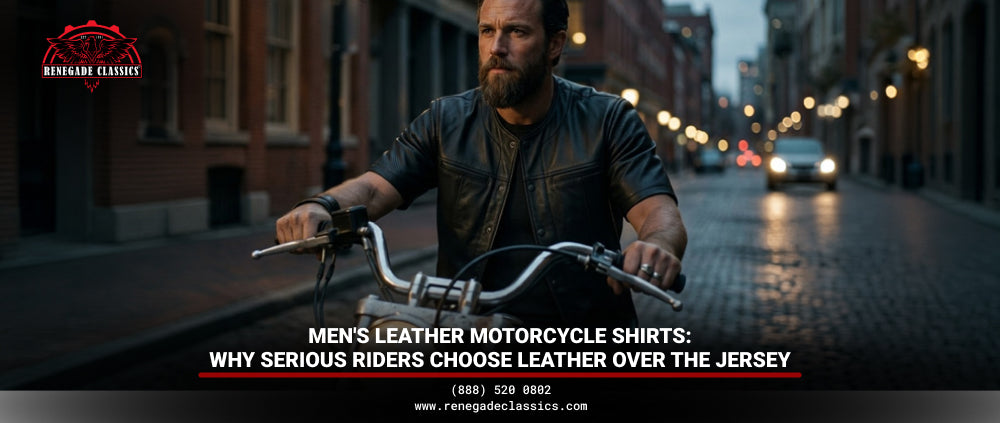
Men's leather motorcycle shirts are the serious rider's choice when protection and identity both matter. They are not for every rider or every riding context. They are heavier than flannel and denim, less breathable in warm weather, and more demanding in terms of care. What they provide in return is the strongest abrasion resistance available in a shirt format and the most direct expression of traditional biker culture identity.
This guide covers what leather provides that other shirt materials do not, how to identify quality leather and construction, the styles available, how to wear and style a leather shirt, and how to care for one properly. It applies to the Harley, cruiser, and V-Twin rider who wants genuine riding quality from their leather shirt rather than a fashion imitation.
For the full material comparison covering leather alongside flannel and denim, see the flannel vs denim vs leather comparison.
What a Leather Shirt Provides That Other Shirts Cannot
The case for a leather motorcycle shirt comes down to three specific properties that no other shirt material provides at the same level.
- Abrasion resistance from the outer surface. Full-grain leather provides meaningful abrasion resistance from the outer fabric itself, not from an inner liner. Flannel and denim shirts rely on aramid lining to provide abrasion resistance. A quality leather shirt delivers this from the hide itself, which means every part of the garment surface contributes to slide protection rather than only the lined zones.
- Wind blocking. Leather blocks wind more effectively than most woven fabric shirts at equivalent weight. In cold weather riding, this wind blocking translates directly to comfort and warmth retention. A leather shirt worn as the outer layer in cool conditions keeps cold air from penetrating in a way that flannel or denim cannot match.
- Cultural identity. Leather is the foundational material of traditional biker culture. A black leather shirt on a Harley rider communicates something specific in the riding community that no other material does. This is not a small consideration for riders who are building a riding wardrobe around a genuine cultural identity.
Leather Grades: What They Mean for Riding
Leather is not a single material. It is processed animal hide, and the grade of that hide determines both the quality and the protective properties of the finished garment. Understanding leather grades is the most important knowledge a buyer needs before purchasing a leather motorcycle shirt.
Full-Grain Leather
Full-grain leather uses the complete thickness of the hide with the natural grain surface intact. It has not been sanded, buffed, or corrected to remove surface imperfections. The natural grain provides a tight, dense fiber structure that is more durable and abrasion-resistant than lower grades.
Full-grain leather develops a patina over time as the natural surface oils interact with use and handling. This patina does not indicate damage. It indicates genuine full-grain leather developing its natural character. A leather shirt that looks identical after ten years of use is more likely to be a lower grade with a uniform finish coating rather than genuine full-grain.
For a riding leather shirt intended for regular use, full-grain is the appropriate choice.
Top-Grain Leather
Top-grain leather is the second grade. The outer surface of the hide is sanded or buffed to remove imperfections and then a finishing coat is applied. This produces a more uniform appearance than full-grain but results in a thinner, less dense fiber structure.
Top-grain leather is durable and commonly used in mid-range leather garments including motorcycle shirts. It provides meaningful abrasion resistance for riding use but is generally considered less durable than full-grain over extended use. For riders who want a quality leather shirt at a more accessible price point, top-grain is a legitimate choice.
Split and Bonded Leather
Split leather is made from the inner layers of the hide remaining after the top grain is separated. It is thinner, weaker, and less abrasion-resistant than either full-grain or top-grain leather. It is often used in fashion leather garments where appearance rather than durability is the priority.
Bonded leather is made from leather scraps and fibers bonded together with adhesives and a polyurethane coating. It is not appropriate for any riding use. Bonded leather peels, cracks, and loses structural integrity significantly faster than genuine leather grades.
Neither split nor bonded leather should be purchased for a motorcycle shirt intended for riding. Both are used in fashion leather products and are sometimes marketed without clear disclosure of their grade.
What to Look for on the Product Label
When buying a leather motorcycle shirt:
- Look for the hide type and grade stated explicitly in the product description. "Genuine leather" is a legal designation but does not specify grade. It can legally refer to split leather.
- "Full-grain leather" or "top-grain leather" should be specifically stated. If neither term appears, ask the retailer or check with the brand directly.
- Hide thickness in millimetres is sometimes listed for riding-specific leather garments. Thicker hide generally provides more abrasion resistance, though the specific weave and processing also affect performance.
Construction Features That Separate a Riding Leather Shirt from a Fashion One
Hide Thickness
Garment leather varies in thickness. Thicker hide provides more material between the rider and road surface in a slide. Fashion leather shirts are often made from thinner leather optimized for drape and flexibility. Riding leather shirts use thicker hide that balances abrasion protection with wearability.
If hide thickness is listed in the product description, it is a useful quality indicator. If it is not listed, the overall weight of the garment is a proxy indicator. A leather shirt that feels very light is likely thinner leather.
Seam Construction
Seam quality in a leather shirt follows the same principles as in denim. Double-stitched seams at the shoulders and underarms provide more structural integrity than single-stitched seams. Some riding leather garments use hand-stitched or saddle-stitched seam construction at stress points for maximum durability.
In a leather shirt, seam failure is more consequential than in a fabric shirt because leather does not stretch or give in the same way. A seam failure in leather can result in a more abrupt failure than in fabric garments, which makes initial seam quality more important.
Closures and Hardware
Leather motorcycle shirts typically use snap closures, zip closures, or a combination of both. Snap closures on leather shirts should use heavy-duty metal snaps rather than lightweight plastic or die-cast alternatives. The snap attachment to the leather requires a reinforced eyelet to prevent the snap from pulling through the hide under stress.
Hardware quality on a leather shirt is visible in the finish and weight of the snaps, zipper pulls, and any rings or D-rings on the garment. Heavier hardware from established hardware manufacturers indicates a garment built to riding standards rather than fashion standards.
CE Armor Pockets
Some men's leather motorcycle shirts include dedicated CE armor pockets at the shoulders and elbows. This adds CE-certified impact protection to the leather's abrasion resistance, providing a more comprehensive protection profile than leather alone.
A leather shirt with CE armor pockets is the strongest protection available in the motorcycle shirt category. As with all armored garments, verify that CE-certified inserts are included and not just the pockets. Check the insert label for a CE Level 1 or Level 2 designation.
The Styles Available in Men's Leather Motorcycle Shirts
Classic Black Biker Leather Shirt
The classic black leather shirt is the most recognizable style in the category and the most deeply embedded in traditional biker culture. It features a clean silhouette, snap or zip front closure, chest pockets, and a shirt-length hem. The absence of unnecessary detailing is part of the aesthetic. A classic black leather shirt communicates a specific and direct identity in the Harley riding community.
This style works as a standalone outer layer in cool weather, as a layering piece under a leather vest, and as a statement garment at any riding event or rally where leather is the expected material.
Western Cut Leather Shirt
The Western cut leather shirt adds front and back yokes, sometimes with fringe detailing, and a silhouette that references the American Western heritage within motorcycle culture. This style suits riders whose identity sits at the intersection of Western Americana and traditional biker culture.
Western cut leather shirts are more visually elaborate than the classic black style and suit events and riding contexts where individual expression is part of the culture. They pair naturally with jeans, boots with Western detailing, and the broader Western-influenced biker aesthetic.
Utility Leather Shirt with Armor Pockets
The utility leather shirt prioritizes function over classic or Western aesthetic. It includes CE armor pockets at the shoulders and elbows, reinforced seam construction, and a cut specifically designed for riding posture. This style is less visually traditional but provides the most comprehensive protection of the three.
For riders who want a leather shirt primarily for its protective properties and are less concerned with aesthetic tradition, the utility cut is the right choice. For riders who want the traditional identity statement that leather carries, the classic or Western cut serves that purpose better.
Browse men's leather shirts at Renegade Classics for the full range of men's leather motorcycle shirt styles.
Leather Shirt vs Leather Jacket: What Each One Does
A leather motorcycle shirt is not a substitute for a leather jacket in high-speed or severe riding conditions. Understanding what each garment provides helps the rider make the right choice for their specific riding context.
- Surface coverage: A leather jacket provides abrasion-resistant coverage across the full chest, back, and arms with a structured outer shell. A leather shirt provides similar coverage without the structural reinforcement of a jacket build.
- Wind protection: A leather jacket with a full front zip and wrist closures blocks wind more completely than a shirt. A leather shirt with snap closures provides meaningful wind blocking but not the complete seal that a jacket closure system provides.
- Versatility: A leather shirt is lighter and more versatile than a jacket. It transitions more naturally to off-bike wear and works across a wider temperature range. A jacket is a purpose-specific riding garment that is less comfortable in non-riding contexts.
- Protection level: A leather jacket generally provides more comprehensive protection for high-speed riding than a leather shirt. For sustained highway riding, a jacket is the more appropriate outer garment. A leather shirt is the right choice for lower-speed riding and conditions where the full weight and structure of a jacket is not needed.
For what to pair with a leather vest specifically, the what to wear under a motorcycle leather vest guide covers every shirt option including leather shirts with guidance by temperature and riding type.
How to Style a Men's Leather Motorcycle Shirt
On the Bike
On the bike, a leather shirt works as the primary outer layer in cool to cold conditions. In mild cool weather, wear the leather shirt over a lightweight base layer or graphic tee. In colder conditions, add a thermal or lightweight flannel underneath for additional warmth before putting the leather shirt on.
A leather shirt under a leather vest is the most classic combination for the Harley and cruiser rider who wants the leather identity in both the inner and outer layer. The leather-on-leather combination provides strong wind protection and the most direct expression of traditional biker culture identity.
At a Rally or Event
At rallies and events, the leather shirt stands on its own as the statement garment. Wear it as the primary visible shirt with jeans or riding pants and boots. In warm rally weather, the leather shirt over a plain tee with the front partially open provides the leather identity without excessive heat. In cool rally weather, close it fully and add a vest over the top.
Off the Bike
A quality leather shirt transitions to off-bike contexts in a way that few other riding garments do. The classic black leather shirt reads as a deliberate style choice in bars, restaurants, and casual social settings. It does not look like riding gear off the bike. It looks like a specific and intentional identity statement.
For the full guide to styling motorcycle shirts across on-bike and off-bike contexts, see the motorcycle shirts off the bike styling guide.
How to Care for a Men's Leather Motorcycle Shirt
Daily and Post-Ride Care
After each ride, wipe down the leather shirt with a clean, slightly damp cloth to remove surface dust and road grime. Allow the shirt to air dry naturally at room temperature away from direct heat sources. Do not use a hair dryer, radiator, or direct sunlight to speed drying. Heat applied directly to leather can cause it to stiffen and crack.
Do not machine wash leather. Water penetration disrupts the fiber structure of the hide and causes stiffness and cracking as it dries unevenly. A leather shirt that gets caught in rain should be allowed to dry naturally at room temperature before conditioning.
Conditioning Schedule
Apply a leather conditioner designed specifically for garment leather on a regular schedule. Conditioning helps maintain the leather's flexibility and prevents it from drying out.
A general conditioning schedule:
- Every two to three months for a shirt worn regularly.
- After any exposure to heavy rain that has soaked the leather.
- When the leather surface begins to feel dry or less supple than usual.
- Before long-term storage.
Apply conditioner sparingly and evenly with a clean cloth. Allow it to absorb fully before wearing the shirt. Do not over-condition. Excess conditioner can soften the leather beyond the point that suits riding use and may attract surface grime.
Storage
Store the leather shirt on a wide hanger that supports the shoulders without stretching the leather at the shoulder seams. Narrow wire hangers create pressure points that can cause creasing or marking of the shoulder leather over time.
Store in a cool, dry location away from direct sunlight. Prolonged sunlight exposure fades leather color and contributes to drying. Do not store in a plastic bag or sealed container. Leather needs airflow. Use a breathable fabric garment bag if dust protection is required for long-term storage.
For the comprehensive care guide covering all motorcycle shirt types including leather, see the motorcycle shirt care guide.
What to Read Next
- What to wear under a motorcycle leather vest guide covers every shirt type paired with a leather vest including leather shirts, with guidance by temperature and riding context.
- Motorcycle denim and leather shirts guide covers both denim and leather motorcycle shirts together with a direct material comparison for riders deciding between the two.
- Flannel vs denim vs leather comparison covers all three major motorcycle shirt materials in a direct comparison with a verdict for each riding context.
- Motorcycle shirt care guide covers the care process for all motorcycle shirt types including the detailed leather conditioning and storage process.
The Bottom Line
Men's leather motorcycle shirts are the right choice for riders who want the strongest abrasion protection available in a shirt format, effective wind blocking in cool and cold weather, and the traditional biker culture identity that leather communicates directly.
The trade-offs are real. Leather is heavier than flannel or denim, less breathable in warm weather, and requires ongoing conditioning to remain in good condition. For riders who accept these trade-offs and maintain the shirt correctly, a quality leather shirt is a long-term investment that develops character over time and provides genuine protection ride after ride.
The key is buying the right grade of leather. Full-grain or top-grain from a brand with genuine riding credibility. Not split leather, not bonded leather, and not a fashion shirt that uses leather terminology without leather substance.
Browse men's leather shirts at Renegade Classics for the full range of men's leather motorcycle shirt options built for the Harley and cruiser rider.
Frequently Asked Questions
Why do serious riders choose leather shirts over other materials?
Leather provides abrasion resistance from the outer hide surface itself rather than from an inner liner, wind blocking that woven fabrics cannot match at equivalent weight, and the traditional biker culture identity that has been associated with motorcycle riding for decades. Riders who prioritize these specific properties and are willing to accept the trade-offs of heat and maintenance requirements choose leather for its combination of protection and identity that no other shirt material provides in the same way.
What leather grade is best for a motorcycle shirt?
Full-grain leather is the best choice for a men's leather motorcycle shirt intended for regular riding use. It uses the complete thickness of the hide with the natural grain surface intact, providing the densest fiber structure and the most durable abrasion resistance of the common leather grades. Top-grain leather is the second option and is appropriate for mid-range riding leather shirts. Avoid split leather and bonded leather for any riding application. Always look for the specific grade stated in the product description rather than relying on general terms like 'genuine leather'.
Does a leather motorcycle shirt need CE armor?
A leather shirt without CE armor provides abrasion resistance from the hide surface but does not provide CE-certified impact protection at the joints. CE-certified armor inserts absorb and distribute impact force at the shoulders and elbows, addressing a different injury type than abrasion. For riders who want both abrasion resistance and impact protection, a leather shirt with CE armor pockets and verified CE-certified inserts provides the most comprehensive protection available in the shirt category.
How often should I condition a leather motorcycle shirt?
A general schedule is every two to three months for a shirt worn regularly, after any heavy rain exposure, when the leather surface feels dry or less supple than usual, and before long-term storage. The exact frequency depends on how often the shirt is worn, what conditions it is exposed to, and the specific leather type. Full-grain leather in good condition typically requires less frequent conditioning than thinner or drier leather. Apply conditioner sparingly and evenly, allow it to absorb fully, and do not over-condition.
Can I wear a leather shirt in summer?
Standard leather is not comfortable in genuine summer heat due to its low breathability. In mild summer temperatures or cooler summer evenings, a leather shirt is manageable. In hot weather, the heat buildup inside a leather shirt becomes uncomfortable for most riders on longer rides. Perforated leather, where small holes are punched through the hide surface, improves airflow significantly and extends the usable temperature range of a leather shirt into warmer conditions. If summer use is a priority, look specifically for perforated leather options.


